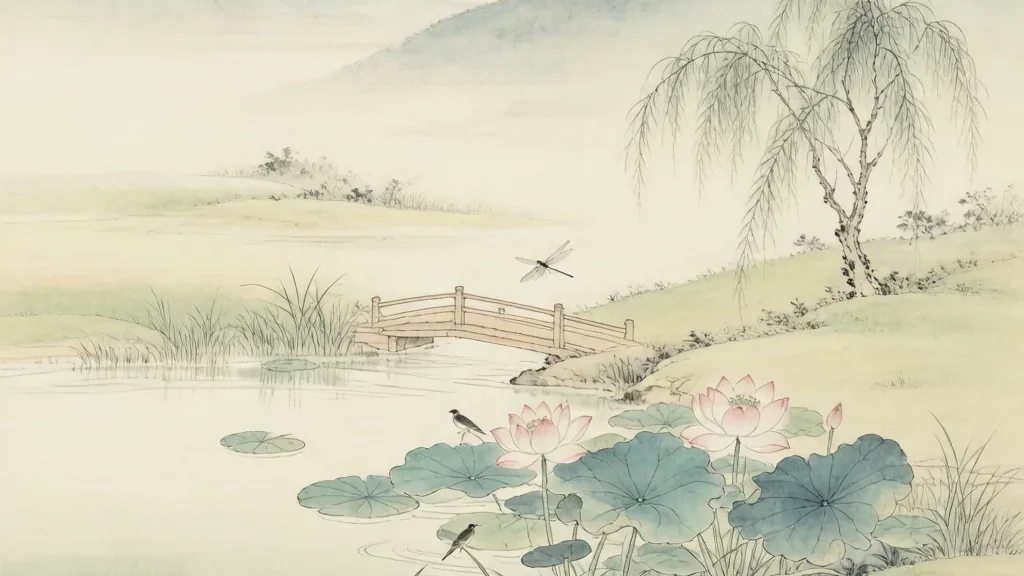
Lixia, or "Beginning of Summer" (立夏), is the seventh of the twenty-four solar terms and the first of the summer season in the traditional Chinese calendar. Usually arriving around May 5 or 6, it marks the moment when the sun reaches the celestial longitude of 45 degrees and the warmth of spring gives way to the rising heat of early summer. For agricultural societies across China, Lixia was far more than a meteorological marker: it signaled the busiest turning point of the farming year, when winter wheat ripened for harvest in the north and rice seedlings were transplanted in the paddies of the south. The term itself combines li (to begin, to stand) and xia (summer), expressing the idea that summer "stands up" and takes its place in the annual cycle.
Astronomical Basis and Calendar Position
Lixia belongs to the group of four "beginning" terms—Lichun, Lixia, Liqiu, and Lidong—that divide the year into the four seasons. Astronomically, it is determined when the apparent position of the sun reaches 45° of ecliptic longitude. In the modern Gregorian-aligned solar term calendar, Lixia typically falls on May 5, 6, or sometimes May 7, depending on the year.
Unlike the equinoxes and solstices, which are anchored to the sun's extreme positions, the "beginning" terms are more cultural than precise. They express the felt experience of seasonal change. Nevertheless, farmers treated Lixia as a hard deadline: fieldwork that lagged behind the term risked reduced yields, since the growing season's window was now open and shortening with every passing day.
Agricultural Significance in North and South
In the Yellow River basin and northern plains, Lixia coincided with the crucial "grab summer" (夏收) period. Winter wheat planted the previous autumn had turned golden and had to be cut, threshed, and dried before the rains. A folk saying warns, "Lixia does not arrive at the sickle" (立夏不拿镰), meaning the harvest tools must already be in hand.
South of the Yangtze, the season meant the transplanting of rice seedlings. Fields were flooded, plowed, and planted in a coordinated rush of communal labor. Because transplanting had to finish before the rains grew too heavy, Lixia was a time of intense, almost competitive work. The contrast between north and south gave the term a double meaning: reaping in one region, planting in another.
The Custom of Weighing People
One of the most distinctive Lixia customs was cheng ren (称人), the weighing of people on a large hanging scale. Families, especially in the Jiangnan region, would weigh children and record the number, believing that knowing one's weight at summer's start helped guard against the seasonal ailments thought to cause weight loss and lethargy in the heat.
The playful ritual was often accompanied by flattering or auspicious words spoken by the person doing the weighing. A heavy child might be told they would grow into a high official; a slim one, that they would be swift and fortunate. The custom blended lighthearted entertainment with a genuine belief that summer heat drained vitality and that vigilance was needed to stay healthy.
Tasting New Summer Foods
Lixia was traditionally a moment to sample the season's earliest produce. In many places people ate "three new things" (尝三新), a set of fresh foods that varied by locality but often included newly harvested cherries, green plums, and the first tender wheat or broad beans.
In some regions, children wore strings of colorful cooked eggs around their necks, a charm against summer sickness, and engaged in the popular game of egg-dueling, tapping eggs together to see whose would crack last. These food customs celebrated abundance and served as a cheerful welcome to the nourishing season after the leaner days of late spring.
Imperial and Literary Observations
During the Zhou and Han dynasties, the emperor performed a ceremonial welcome to summer, leading officials in green robes to the southern suburbs to sacrifice to the deities of fire and the season. The ritual expressed the cosmological belief that the ruler should harmonize human affairs with the turning of the heavens.
Poets of later dynasties left many Lixia verses. They noted the lengthening daylight, the hum of insects, the swelling fruit, and the bittersweet awareness that summer's arrival also meant spring's departure. Such poems reveal how the term functioned as both a farming signal and a lens for reflection on time's passage.
Folk Sayings and Weather Lore
Countless proverbs tied Lixia weather to the harvest. "If Lixia is rainy, the rice granary will be full" expressed the hope that timely rains would secure the crop. Conversely, a dry Lixia aroused anxiety about drought later in the season.
Other sayings linked the term to longer-range predictions, such as observing whether crickets sang early or late, or whether the wind blew from the south or north. While not scientific forecasts, these aphorisms encoded generations of careful observation and gave rural communities a shared vocabulary for reading the sky.
Plants and Wildlife of the Season
The classical "three pentads" (三候) associated with Lixia describe nature's shifts: first, the crickets (or in some versions, the earthworms) stir; second, the 《wangsun》 plant—a kind of fragrant summer herb—begins to grow; third, the kingfishers and certain melons appear. These small signs helped farmers track the season's progress.
In gardens and orchards, loquats ripened, lotus ponds woke from dormancy, and mulberry leaves reached the size needed for silkworm rearing. The silkworm cycle, vital to southern economies, was closely tied to the Lixia period, with households feeding their worms the fresh new leaves.
Lixia in the Modern Calendar
Today Lixia survives mostly as a cultural memory and a marker on lunar calendars and weather apps. In cities, few people weigh themselves or transplant rice, yet the term still appears in almanacs, festival pages, and seasonal menus at restaurants highlighting "summer's first tastes."
Agritourism and heritage projects in places like Jiangsu and Zhejiang have revived Lixia games and foods as local attractions. The term thus bridges ancient rural rhythm and contemporary interest in seasonal living, reminding urban dwellers of the agricultural roots beneath the modern year.
Connection to the Other Summer Terms
Lixia opens the summer arc that continues through Xiaoman (Grain Buds), Mangzhong (Grain in Ear), Xiazhi (Summer Solstice), Xiaoshu (Minor Heat), and Dashu (Great Heat). Each term refines the picture of a season moving from tentative warmth to peak intensity.
Understanding Lixia helps explain why later terms matter: the planting and early growth triggered at summer's beginning determine the harvest celebrated at solstice festivals and the heat endured at its height. The solar terms form a chain, and Lixia is the link that sets summer in motion.
❓ Frequently Asked Questions
When does Lixia usually occur?
Lixia typically falls on May 5 or 6 in the Gregorian calendar, when the sun reaches 45° of ecliptic longitude.
What does the name Lixia mean?
It combines li (to begin or stand) and xia (summer), so it means "Beginning of Summer."
Why did people weigh themselves at Lixia?
The custom was thought to guard against the vitality-draining heat of summer and to monitor health through the season.
What foods are associated with Lixia?
Many regions "taste the three new things," often fresh cherries, green plums, and early wheat or broad beans, plus boiled eggs for children.
How did Lixia affect farming?
It triggered wheat harvest in the north and rice transplanting in the south, making it one of the year's busiest agricultural moments.
Is Lixia still celebrated today?
Mostly as cultural memory, but some regions revive its foods and games through heritage tourism and seasonal menus.