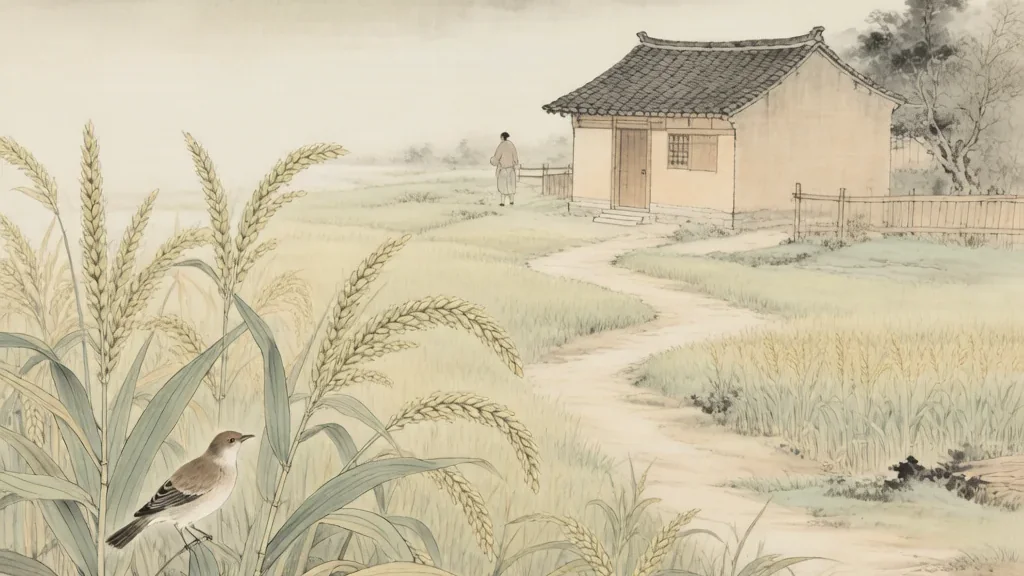
Xiaoman, literally "Lesser Fullness," is the eighth of the twenty-four traditional Chinese solar terms and usually begins around May 20 or 21 in the Gregorian calendar. The name captures a precise agricultural moment: the grains in the fields have begun to fill and swell but have not yet reached full ripeness. Falling between the energy of spring planting and the labor of the summer harvest, Xiaoman marks a threshold of anticipation. In the north, winter wheat approaches maturity; in the south, the rivers and canals swell with the season's increasing rains. The term reflects an old Chinese aesthetic that values the "not yet full" — a state of growing potential rather than饱和 completion — and it carries this philosophy into customs of water, silkworms, and bitter greens.
Position in the Solar Term Calendar
Xiaoman is the second solar term of the summer period, following Lixia (Beginning of Summer) and preceding Mangzhong (Grain in Ear). In the traditional reckoning, the sun reaches the celestial longitude of 60 degrees at the start of Xiaoman. It divides the year as the heat intensifies and the daylight grows long.
The arrival of Xiaoman signals the shift from sowing to tending. Farmers who planted in spring now watch their crops daily, because the window between "filling" and "ripe" is short and weather-sensitive. In the classical agricultural almanacs, Xiaoman was treated as a checkpoint: the land had done its early work, and the harvest was no longer a distant hope but a visible, swelling reality.
The Three Pentads of Xiaoman
Each solar term is divided into three pentads (hou), and Xiaoman's are among the most evocative. The first pentad is "the bitter cabbage flourishes" (ku cai xiu), noting that edible bitter greens thrive in the warming soil. The second is "the shade-loving weeds wither" (mi cao si), as stronger sun and drier conditions kill off tender plants that prefer cool shade.
The third pentad is "the wheat reaches its autumn" (mai qiu zhi). Although it is spring, "autumn" here refers to the wheat's own harvest season; the grain completes its life cycle now. These three observations together describe a landscape tipping from cool to warm, from green abundance to the first golden fields of the year.
Agriculture: Wheat in the North, Rain in the South
In the North China Plain, Xiaoman is the season of winter wheat. The ears fill with milky starch, and the stalks turn from green to a pale straw color. A timely harvest a few weeks later depends on the crop surviving this filling stage without storm or disease. Farmers watch the sky anxiously, because a late downpour or wind can flatten the standing grain.
In the Yangtze River valley and farther south, Xiaoman brings the onset of the plum-rain season (meiyu), when warm, humid air from the south meets cooler northern air and produces long, steady rains. The paddies are flooded for rice transplanting, and the waterways must be managed with care. Too little water stalls the rice; too much floods the young plants.
The Custom of Honoring the Waterwheel God
Because Xiaoman is a time when both irrigation and drainage matter, many farming communities once held rituals to the "waterwheel god" or "cart god" (che shen). Households offered sacrifices beside their water-lifting wheels, placing food, incense, and sometimes a small cup of water on the axle. The belief was that showing respect would bring reliable water and protect the machinery through the busy months.
In some regions the ritual included casting a cup of water into a stream and reading the ripples as an omen for the coming rains. Such practices bound the technology of irrigation to a sense of gratitude and humility toward the forces that governed the weather, reminding communities that human effort alone could not guarantee a harvest.
Silkworm Reverence and the Silk Goddess
Xiaoman overlaps with the season when silkworms, fed on fresh mulberry leaves, spin their cocoons. In the silk-producing regions of the lower Yangtze, especially around modern Jiangsu and Zhejiang, households that raised silkworms treated Xiaoman as a small festival. They offered sacrifices to the "silkworm goddess" (can shen) and to Lord Liu, a semilegendary figure associated with sericulture.
The work was intensive and demanding: the worms ate almost continuously, and the rooms had to be kept clean, quiet, and at an even temperature. A good cocoon crop meant income for the family; a failed one meant hardship. The Xiaoman observances thus mixed devotion with practical urgency, and the period was marked by both reverence and round-the-clock labor.
Eating Bitter Greens
Xiaoman's first pentad names the bitter cabbage, and eating bitter greens is a recurring theme of the term. Plants such as ku mai cai (a kind of sow thistle) and other wild bitter leaves were gathered and lightly cooked. In traditional dietary thinking, bitter foods were believed to clear heat and dampness from the body as the weather grew hot and humid.
This is not merely folklore. Bitter greens are rich in nutrients and provide a refreshing contrast to heavier foods. Served with garlic, vinegar, or a little fermented bean, they remain a seasonal dish in many parts of China, connecting the modern table to an ancient calendar of what the earth offers at each turning of the year.
Flood Management and the Canals
The rising waters of Xiaoman made the term a practical test of community organization. Villages along the rivers maintained dikes, cleared silt from channels, and coordinated the sharing of water among neighboring fields. Disputes over irrigation were common, and local custom often assigned an elder or a temple committee to arbitrate.
In the plum-rain south, the challenge was the opposite: too much water. Drainage ditches had to be opened, and low fields protected. The term thus taught a lesson still relevant today — that living with the land means constant, unglamorous maintenance, and that abundance depends as much on drainage as on rainfall.
The Philosophy of "Not Yet Full"
The name Xiaoman has long appealed to Chinese literati because it embodies a cultural preference for moderation. "Fullness" (man) suggests completion and, by implication, decline; the old saying "man zhao sun" warns that fullness invites loss. Xiaoman, by stopping short of full, preserves the promise of more to come.
Poets and painters used the term to praise the half-opened lotus, the not-quite-ripe fruit, the verse not yet finished. In this sense Xiaoman is more than a farming marker; it is a small philosophy of restraint, teaching contentment with the growing rather than the attained, and finding beauty in the moment before culmination.
Weather Lore and Proverbs
Xiaoman generated a rich store of weather proverbs used to forecast the harvest. One common saying notes that if Xiaoman brings little rain, the rivers will be low by the time of Mangzhong. Another warns that a windy Xiaoman portends a poor rice year. Such proverbs condensed generations of observation into memorable lines that even children could recite.
While not scientific forecasts, these sayings reflect a real, close attention to local microclimates. They remind us that before modern meteorology, the calendar itself was a forecasting tool, and the solar terms were the farmers' almanac, updated by experience year after year.
Xiaoman in Modern Life
Today most urban Chinese no longer farm, yet the solar terms retain cultural currency through food, social media, and seasonal marketing. Restaurants may highlight bitter greens in late May; heritage towns along the canals revive silkworm rituals as tourism; and calligraphy and painting exhibitions sometimes take the term as a theme.
The deeper appeal of Xiaoman endures because it speaks to a widely felt desire to slow down and appreciate process over result. In a fast-paced society, the image of grain that is filling but not yet full offers a gentle corrective — a reminder that growth takes time, and that the ripening is its own kind of beauty.
❓ Frequently Asked Questions
When does Xiaoman usually begin?
Xiaoman typically starts around May 20 or 21 in the Gregorian calendar, when the sun reaches a celestial longitude of 60 degrees.
What does the name Xiaoman mean?
It means "Lesser Fullness" and refers to grain that has begun to fill with starch but has not yet ripened fully.
What are the three pentads of Xiaoman?
They are the flourishing of bitter cabbage, the withering of shade-loving weeds, and the wheat reaching its harvest season.
Why were silkworms important at Xiaoman?
Xiaoman overlaps with the cocoon-spinning season, and silk-producing regions held rites to the silkworm goddess for a good crop.
What foods are eaten during Xiaoman?
Bitter greens such as sow thistle are traditional, valued for clearing heat and dampness as the weather warms.
How is Xiaoman observed today?
Though few farm now, the term lives on through seasonal foods, heritage rituals, and cultural themes of moderation and growth.