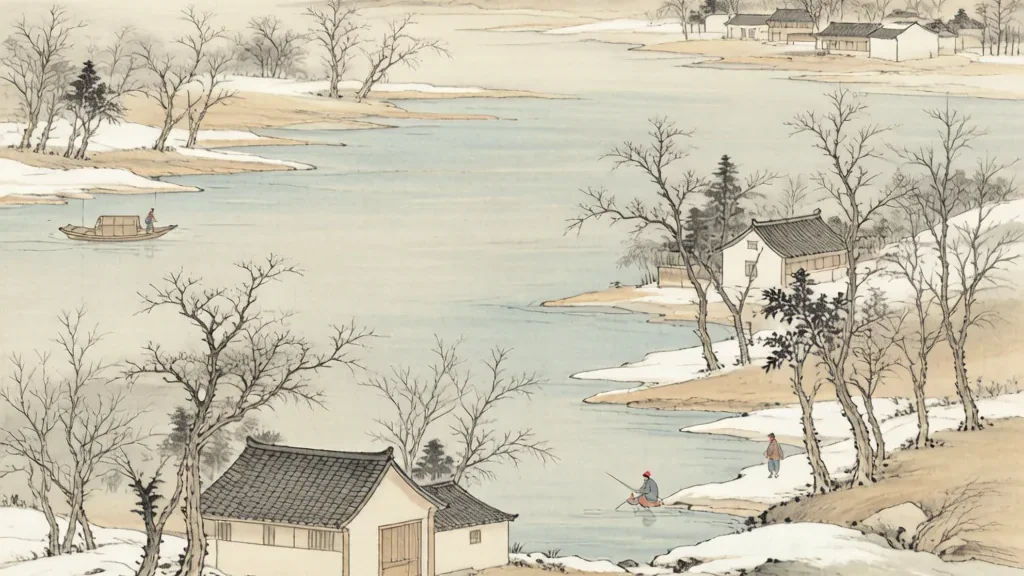
Dongzhi, the "Winter Solstice" (冬至), is the twenty-second solar term and one of the most important seasonal festivals in Chinese culture, usually falling around December 21 or 22. When the sun reaches the ecliptic longitude of 270 degrees, the Northern Hemisphere experiences its shortest day and longest night. The name means "winter's extreme arrival," and in the yin-yang cosmology it marks the depth of yin and the first stirring of returning yang. Historically, Dongzhi was observed as a major celebration—often called the "Second New Year"—with family reunions, ancestral rites, and the eating of dumplings in the north or tangyuan (glutinous rice balls) in the south. More than a calendar point, it was a festival of light returning and of family togetherness at the year's darkest hour.
Astronomical Significance
Dongzhi is fixed by the sun's position at 270° of ecliptic longitude, the moment the North Pole tilts farthest from the sun. Daylight is at its minimum and the noon shadow at its longest, the inverse of the summer solstice.
Ancient astronomers measured this shadow with gnomons, just as at Xiazhi, making the winter solstice a precise and venerable observational anchor. Its regularity allowed it to serve as a cornerstone for calibrating the lunar-solar calendar.
"Yang Begins to Grow"
In yin-yang thought, Dongzhi is the extreme of yin—darkness and cold—yet the very point at which yang begins to return. The saying "yang is born at the winter solstice" (冬至一阳生) frames the day as a birth of light.
This made the solstice hopeful rather than merely bleak. The longest night was also the turning: from the next dawn, daylight would slowly lengthen. The idea underpinned the festival's optimism and its emphasis on renewal.
A Festival Equal to New Year
In imperial and pre-modern China, Dongzhi was a grand occasion, sometimes ranking with the Lunar New Year. Officials were granted leave, households cleaned and decorated, and families gathered for a reunion meal.
The saying "Winter solstice is as important as the New Year" (冬至大如年) expressed its stature. In some regions people visited elders and exchanged small gifts, echoing New Year customs and affirming social bonds at year's end.
Dumplings in the North
A beloved northern custom is eating dumplings (饺子) on Dongzhi, linked to the legend of a physician who, in cold times, fed villagers ear-shaped dumplings in Warming Soup to prevent frostbitten ears. The tale explains why many still eat them that day.
Beyond the legend, dumplings were practical winter fare—hot, filling, and communal to make. The act of wrapping and boiling together turned the solstice meal into a household ritual of warmth and care.
Tangyuan and Southern Customs
In the south, especially around Jiangnan, families eat tangyuan—sweet glutinous rice balls in broth—symbolizing reunion and the addition of a year to one's life. Their round shape echoes completeness and family unity.
Some southern households also make offerings of tangyuan at ancestral altars and to the hearth, blending the festive meal with reverence for forebears. The southern and northern foods differ, but both center on togetherness.
Ancestral Worship and Rites
Dongzhi was a key time for honoring ancestors. Families presented food, incense, and paper offerings, inviting the spirits of the departed to share the season's turning. The rite reinforced continuity between generations.
In some lineages, the solstice gathering doubled as a clan meeting to review genealogies and settle affairs. The festival thus wove the living and the remembered into a single annual occasion of renewal.
The "Nine-Nine" Counting of Winter
A charming custom was the "Nine-Nine Winter Song" (九九歌), counting eighty-one days from Dongzhi in nine sets of nine, tracking the gradual thaw. Each period described changing weather, from freezing to the return of spring.
Some painted "nine-nine消除图" or kept calendars marking the passage. This practice turned the long cold into a measurable, hopeful countdown, a folk method of enduring winter through attentive observation.
Health and Diet at the Solstice
Traditional health advice treated Dongzhi as a time to nourish and conserve, eating warming foods and avoiding excess. The body, like the year, was thought to need building up at its low point.
Tonica-like soups, mutton, and rice wines featured in some regions. The regimen echoed the broader belief that the solstice's turning demanded care so that vitality could rise with the returning light.
Dongzhi in the Modern World
Today Dongzhi remains widely observed through food: northern families still make dumplings, southerners still boil tangyuan, and many share the meal with relatives. Almanac apps and media mark the day with explanations of its astronomy and customs.
In a fast-paced society, the solstice endures as a rare pause for family and reflection at the year's darkest point. Its message—that light returns after the longest night—resonates as both seasonal fact and quiet metaphor for hope.
Dongzhi Across the Chinese Cultural Sphere
The Winter Solstice was observed far beyond the heartland, traveling with Chinese communities throughout East Asia. In regions with shared cultural roots, analogous customs appear: the emphasis on a reunion meal, on warming foods, and on marking the year's darkest point with family gathered close.
In overseas Chinese communities today, Dongzhi remain a living tradition, with tangyuan meals and family gatherings that connect diaspora households to their heritage. The festival's portability—centered on food and family rather than elaborate ritual—helped it survive migration and urbanization.
This wide observance underscores Dongzhi's deep cultural root as a festival of light's return and human togetherness. Whether in a village ancestral hall or a city apartment, the longest night is met with the same instinct: eat, remember, and trust that the days will lengthen again.
❓ Frequently Asked Questions
When does Dongzhi occur?
Dongzhi typically falls around December 21 or 22, when the sun reaches 270° of ecliptic longitude and daylight is shortest.
Why is Dongzhi a festival, not just a term?
Historically it was observed as a major reunion and ancestral rite, sometimes equal to the New Year, hence its festival status.
What is the difference between northern and southern foods?
Northerners eat dumplings; southerners eat tangyuan rice balls—both symbolize warmth and family unity.
What does yin-yang say about Dongzhi?
It is yin's extreme yet the moment yang is born, making the longest night the turning point toward light.
What is the "Nine-Nine Song"?
A folk counting of eighty-one days from the solstice in nine groups of nine, tracking winter's slow retreat.
Is Dongzhi the same as Lidong?
No. Lidong begins winter in early November; Dongzhi is the December solstice about six weeks later.