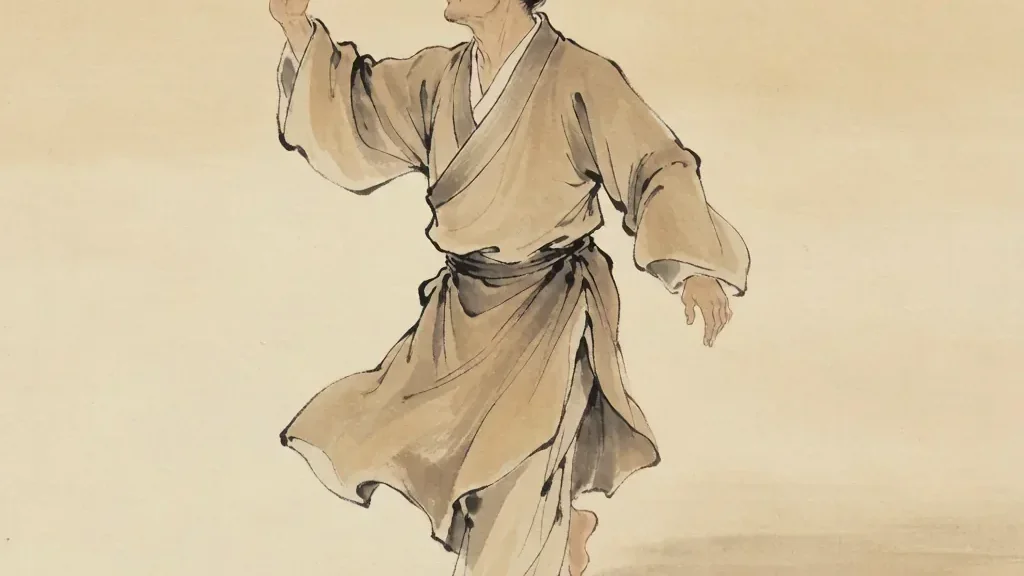
Of all the images of Chinese martial arts, few are as unforgettable as the "drunken master": staggering, wobbling, seemingly helpless—then striking with stunning precision from a fall. This is Zuiquan (醉拳, ), "Drunken Boxing." Far from a comedy routine, it is a sophisticated style built on off-balance stances, deceptive posture, and sudden explosive recovery. It matters because it turns weakness into strategy: by appearing clumsy and vulnerable, the drunkard invites attack and punishes it. For students of Chinese martial culture, Zuiquan is the clearest proof that illusion and psychology are as much a part of kung fu as muscle.
Origins in Myth and the Eight Immortals
Zuiquan's lore ties it to Daoist hermits and to the Baxian (八仙), the Eight Immortals of Chinese folklore, several of whom are depicted as cheerful drunkards. The most associated is Li Tieguai (李铁拐), the lame beggar-immortal, and Liuxian figures whose unsteady gait hides power. Legend says wandering adepts, sometimes genuinely tipsy, developed movements that mimicked intoxication to confuse opponents and to free the body from rigid, predictable posture.
Historically, drunken boxing appears within several northern and southern styles as a set of specialized forms rather than a separate school. It drew on the same observation of nature and eccentricity that produced the animal styles, but its "animal" was the human drunkard. The style's playful mythology should not disguise its seriousness: the stances are demanding, the falls are controlled, and the transitions require exceptional core strength. What looks like chaos is in fact a rigorously trained disorder.
The Art of Off-Balance Stance
The technical heart of Zuiquan is the use of off-balance and low, broken stances—sitting on one knee, leaning at impossible angles, supporting the body on an elbow, or spinning from a near-fall. These positions are deliberately weak in appearance and often genuinely disadvantaged if held, which is why the style never lingers in them. The practitioner flows through them, using the momentum of a "stumble" to generate a strike or to escape.
This constant motion makes the drunkard maddening to fight. A normal opponent expects a stable base and a readable guard; Zuiquan offers neither. Because the body is already "falling," it can drop below an attack, roll into a kick, or spring upward from the ground with a head butt or palm. The low center of gravity in the kneeling and squatting postures also makes the fighter hard to uproot. The apparent clumsiness is a trap laid with the whole body.
Deception, Timing, and the "Drunk" Persona
Zuiquan is above all a psychological style. The performer slurs, weaves, and giggles; the guard is slack; the eyes seem unfocused. A confident attacker closes in—and is met by a sudden, perfectly timed counter. The deception works because it exploits the opponent's assumptions about how a fighter should look and move. In Chinese strategic terms, it is the principle of "appearing weak when strong."
Timing is everything. The "drunken" swaying builds a rhythm that lulls the opponent, then breaks it with an explosive technique launched from a position no one would guard against. Practitioners train this by drilling the forms until the transitions are unconscious, so the "act" becomes a real skill rather than a performance. The best drunk-boxers are solemn in training and only "drunk" in application, a discipline that separates the art from mere theatrics.
Forms: The Eight Drunken Immortals
Many Zuiquan curricula are organized around the Eight Immortals, with each immortal contributing a flavor of movement—one limping, one reeling, one seated, one floating. These "eight drunks" forms chain together low sweeps, spinning falls, shoulder rolls, and unexpected strikes such as the "drunken whip" and the "immortal pointing the way." The variety keeps training fresh and covers a wide range of combat distances.
Beyond the immortals sets, there are shorter "small drunken" routines suitable for beginners and longer "big drunken" forms for advanced students. Weapons are sometimes included—most famously the drunken saber or the drunken staff—where the wobbling gait adds deception to an already dangerous tool. In all cases the forms are less about looking drunk than about mastering the unusual biomechanics of fighting from compromised positions, which is exactly what makes the style so effective and so hard to learn.
Conditioning and the Real Difficulty
Contrary to its lazy appearance, Zuiquan is physically grueling. The low, asymmetric stances demand strong quadriceps, flexible hips, and a powerful core to control the constant descent and recovery. Rolling and falling safely require the breakfall skills shared with other arts, plus the courage to drop toward the ground repeatedly. Joint mobility, especially in the spine and shoulders, determines how convincing and how functional the swaying can be.
Training therefore begins with fundamentals borrowed from the parent style—stance, balance, and basic strikes—before the drunken layer is added. A student who cannot hold a stable horse stance will never manage a controlled fall-and-strike. Teachers stress that the "drunken" quality is the last thing learned, not the first; without a solid base, the disorder collapses into actual clumsiness. This rigor is why authentic Zuiquan is respected even by skeptics of flashy kung fu.
Zuiquan in Film and Popular Culture
No style owes more of its global fame to cinema than drunken boxing. The 1978 film Drunken Master starring Jackie Chan turned it into a household concept and showcased its comedic potential alongside real technique. Earlier and later films, including those about the "Drunken Master" and the "Eight Drunken Immortals," cemented the wobbling fighter as a beloved archetype. These portrayals, while entertaining, tend to exaggerate the comedy and understate the discipline.
The pop-culture image is both a gift and a distortion. It draws newcomers to Chinese martial arts and preserves the forms in public memory, yet it can make the style seem like a gag. Serious practitioners push back by demonstrating the genuine biomechanics: the low stance work, the deceptive timing, the explosive recovery. For the cultural learner, the right takeaway is that Zuiquan uses play as a mask for precision—a very Chinese idea, where the sage sometimes wears the fool's face.
Biomechanics Of The Falling Strike
The signature move of Zuiquan is the drunken fall, a controlled drop to the ground that looks like losing balance but is in fact a tactical entry. From a kneeling or near-fallen position the practitioner can roll into a kick, spring upward with a head butt or palm, or whip a strike from below an opponent's guard. Because the body is already 'falling,' it can drop beneath an attack that a standing fighter would have to block, turning apparent weakness into an angle no one defends. The low center of gravity in squatting and kneeling postures also makes the drunkard hard to uproot, so attempts to push them over simply meet resistance they did not expect. Training this safely requires breakfall skill and strong hips, which is why the style is physically demanding despite its lazy appearance. The falling strike is the clearest example of Zuiquan's rule: the clumsier it looks, the more deliberate it is.
Drunken Boxing As Cultural Philosophy
Beyond technique, Zuiquan carries a distinctly Chinese philosophical message about appearance and reality. Its central tactic, appearing weak while actually strong, echoes the Daoist teaching that the sage may wear a fool's face and that softness can overcome rigidity. The drunkard's laughter and slack guard are a deliberate mask, a performance that lulls the opponent into underestimating the fighter. This makes the style a kind of embodied paradox: the more convincingly you play the fool, the more dangerous you become. Storytellers and filmmakers latched onto that paradox, which is why drunken boxing reads as both comedy and wisdom in popular culture. For the learner, the right takeaway is that Zuiquan uses play as camouflage for precision, a reminder that in Chinese martial thought the theatrical and the profound are often the same thing wearing different clothes.
❓ Frequently Asked Questions
📝 Chinese Vocabulary
醉拳 — : Drunken Boxing.
八仙 — : the Eight Immortals of folklore.
醉八仙 — : the Eight Drunken Immortals forms.
醉步 — : drunken step, the reeling footwork.
醉棍 — : drunken staff, a weapon variation.
醉拳 — : Drunken Boxing, the empty-hand drunken style
醉倒 — : drunken fall, a controlled drop used to evade and counter
醉鞭 — : drunken whip, a whipping strike from a low position
🎉 Fun Facts
- Zuiquan is often taught as a specialized set within a larger style rather than as an independent school.
- The 1978 film Drunken Master with Jackie Chan made the style world-famous, blending real technique with comedy.
- Several of the Eight Immortals it imitates, like Li Tieguai, are themselves depicted as lame or beggar-like—perfect models for off-balance fighting.
- The style embodies the Chinese strategic principle of "appearing weak while actually strong."
- Zuiquan's low stances demand unusually strong thighs because the fighter spends so much time near the ground.
- Authentic training forbids real alcohol; the 'drunken' state is purely a trained act of posture and rhythm.