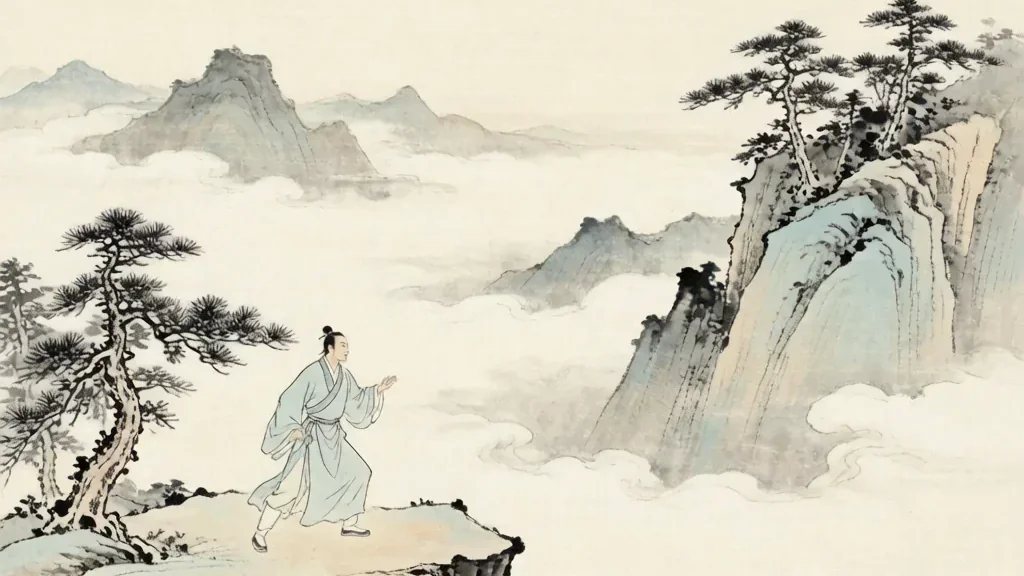
The Emei School (峨眉派, Emei Pai) is one of the three great traditional schools of Chinese martial arts, alongside Shaolin and Wudang. Named after Mount Emei (峨眉山) in Sichuan province — one of China's Four Sacred Buddhist Mountains — the Emei School is distinguished by its synthesis of Buddhist and Daoist influences, its legendary association with female practitioners, and its distinctive style that emphasizes fluidity, precision, and the redirection of force. Unlike Shaolin's external power and Wudang's internal softness, Emei occupies a unique middle ground, integrating hard and soft, fast and slow, linear and circular movements into a comprehensive system. In Chinese martial arts lore, the Emei School is the most mysterious of the three great schools, a tradition born from the mist-shrouded peaks of a sacred mountain and nurtured within the quiet walls of Buddhist nunneries.
Origins: The Sacred Mountain and the Birth of a Martial Tradition
Mount Emei rises 3,099 meters above the Sichuan basin, its summit often wrapped in clouds and its slopes covered with ancient temples, many of them nunneries. The name "Emei" itself is said to derive from the mountain's distinctive shape — two peaks facing each other like the delicate eyebrows (蛾眉) of a classical Chinese beauty, a fitting origin for a martial art historically associated with women. Buddhism arrived on Emei in the 1st century CE, and by the Tang dynasty (618–907) it had become a major pilgrimage center, particularly associated with the Bodhisattva Samantabhadra (普贤菩萨), who is often depicted riding a six-tusked white elephant and representing the practice and application of Buddhist teachings. According to tradition, the Emei martial arts were founded during the Southern Song dynasty (1127–1279) by a female practitioner, though accounts vary on her identity. Some traditions point to a Daoist nun known as the "Emei Immortal" who retreated to the mountain to cultivate longevity practices and developed combat techniques as a form of moving meditation. Others speak of a Buddhist nun who synthesized existing local fighting techniques with the meditative disciplines of the monastery. The school's most famous legendary founder is Guo Xiang (郭襄), a fictional character from Jin Yong's novel "The Return of the Condor Heroes," who is portrayed as a brilliant young woman who, after a series of adventures and heartbreaks, establishes the Emei Sect as a refuge for women seeking martial training and spiritual fulfillment.
Women Warriors: The Emei School's Female Martial Tradition
The Emei School's most distinctive feature is its long-standing tradition of female martial arts practice. In traditional Chinese society, where women's physical training was often discouraged, the nunneries of Mount Emei provided a rare space where women could develop combat skills without social stigma. The school's techniques were adapted to suit practitioners with smaller frames and less upper-body strength, emphasizing leverage, speed, precision, and agility over brute force. The Emei piercers (峨眉刺) — paired metal spikes worn on rings on the middle fingers — epitomize this philosophy. These weapons allow a practitioner to strike vital points with surgical precision while maintaining the appearance of an empty hand, a design that reflects the school's emphasis on deception and efficiency. Other signature weapons include the Emei soft whip and the Emei flower basket, the latter a seemingly innocuous household object that conceals deadly blades — a weapon that only a woman could carry without suspicion. Throughout Chinese history, the Emei School produced numerous legendary female martial artists. Stories speak of Abbess Lingyun, who defended her temple against bandits in the Ming dynasty using only a pair of Emei piercers, and of the "Nine Swords of Emei," a group of nine warrior nuns who protected pilgrims traveling to the mountain. These tales, while embellished through generations of oral transmission, reflect a genuine tradition of female martial agency that was rare in pre-modern China and continues to inspire women in martial arts today.
Historical Development and the Buddhist Connection
The historical development of the Emei School spans over 800 years, evolving through distinct phases shaped by political and religious changes. During the Ming dynasty (1368–1644), Emei martial arts were systematically codified by monks and nuns who organized the techniques into structured forms and created written manuals for transmission. The school reached its peak during the Qing dynasty (1644–1912), when Emei practitioners were renowned throughout Sichuan for their combat effectiveness. The Buddhist connection runs deep in every aspect of Emei practice. Many of the school's forms are named after Buddhist concepts — the "Samantabhadra Form," the "Lotus Flower Palm," and the "Bodhisattva Staff" — and the training regimen incorporates Buddhist meditation practices as an integral component. The famous "Emei Twelve Zhuang" (峨眉十二桩), a series of standing meditation postures, draws directly on the Buddhist tradition of sitting meditation (zuochan, 坐禅) but adapts it into dynamic, standing forms that simultaneously train the body and calm the mind. Each posture corresponds to a particular quality cultivated in Buddhist practice — compassion, patience, wisdom, and equanimity — transforming martial training into a path of spiritual development. The late 19th and early 20th centuries brought challenges as modern firearms diminished the practical value of traditional martial arts, but Emei adapted by emphasizing its health and spiritual cultivation aspects. Since the 1980s, the Chinese government has supported the revival of Emei martial arts, establishing research institutes dedicated to preserving its complete curriculum.
Abbess Miejue and Emei in Martial Arts Culture
The Emei School entered the global imagination primarily through Jin Yong's wuxia novels, and no character looms larger in this literary tradition than Abbess Miejue (灭绝师太), the fearsome leader of the Emei Sect in "The Heaven Sword and Dragon Saber" (倚天屠龙记). Her name, Miejue, means "Extinction" — a title that reflects her uncompromising nature and her mission to eradicate evil from the martial world. Miejue is one of Jin Yong's most complex antagonists: a woman of immense skill and iron will, whose rigid moral absolutism and tragic backstory — her fiancé was killed by the enemies of the Emei Sect — have hardened her into a figure of terrifying righteousness. She wields the legendary Emei sword technique with devastating effect, and her famous line, "To eliminate demons, one must first become a demon oneself," encapsulates the moral ambiguity at the heart of the wuxia genre. Her disciple, Zhou Zhiruo, undergoes one of Jin Yong's most compelling character arcs, transforming from a gentle, innocent girl into a calculating and ambitious sect leader — a transformation that critiques the very system of martial hierarchy and revenge that Miejue embodies. Beyond Jin Yong's novels, the Emei School has appeared in countless films, television series, and video games, cementing its place in the global cultural imagination as the archetypal "women's martial arts school." In reality, Emei martial arts are practiced today in Sichuan and at branches worldwide, preserved by a small number of lineage holders. The style was recognized as part of China's National Intangible Cultural Heritage, and efforts are underway to document and transmit its complete curriculum before the older generation of masters passes away. Annual Emei martial arts festivals draw practitioners from around the world to the mountain's slopes, where the sound of chanting and the flash of blades still echo through the misty valleys.