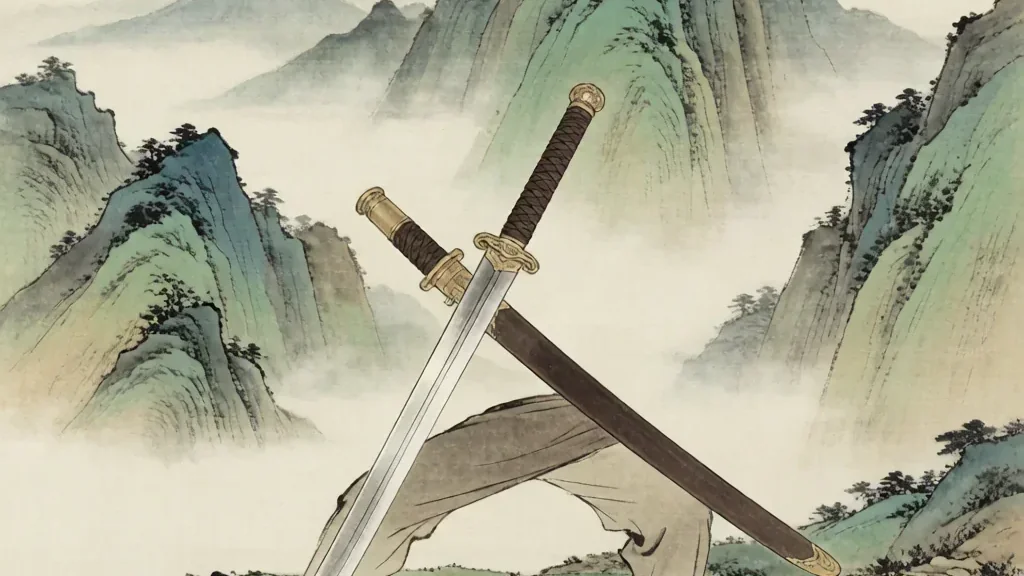
Wudang Tai Chi Sword (武当太极剑), also known as Wudang Sword, is the signature weapon art of the Wudang Mountains (武当山) in Hubei province, the spiritual home of Daoist martial arts. More than a combat technique, Wudang sword is a form of moving meditation — a practice in which the practitioner's body, breath, mind, and blade unite in flowing sequences that embody the Daoist principles of yielding, circularity, and the reconciliation of opposites. The Wudang sword tradition traces its lineage to the legendary Daoist immortal Zhang Sanfeng (张三丰), who is said to have created the internal martial arts after witnessing a snake and a crane engaged in combat. While the historical Zhang Sanfeng is a shadowy figure, the martial tradition that bears his name is very real — a living art practiced by thousands worldwide who seek to harmonize body, breath, and blade in the pursuit of martial excellence and spiritual cultivation.
The Wudang Mountains and the Legend of Zhang Sanfeng
The Wudang Mountains, a UNESCO World Heritage Site, have been a center of Daoist practice since at least the Eastern Han dynasty (25–220 CE). The mountain range's 72 peaks, 36 cliffs, and 24 ravines create a landscape of extraordinary beauty that Daoist tradition regards as a terrestrial paradise, the earthly residence of the Perfected Warrior (真武大帝, Zhenwu Dadi), the martial manifestation of the Dao. During the Ming dynasty (1368–1644), the Yongle Emperor sponsored a massive construction project on Wudang, building a complex of temples, palaces, and monasteries connected by stone paths that climb the mountain's slopes. The emperor, who had usurped the throne from his nephew and sought divine legitimation, claimed Zhenwu as his celestial protector and turned Wudang into an imperial Daoist center. This imperial patronage attracted martial artists, alchemists, and hermits to the mountain, creating the conditions for Wudang's emergence as a major martial arts center. At the heart of Wudang's martial tradition stands the semi-mythical figure of Zhang Sanfeng (张三丰). According to legend, Zhang Sanfeng was a Daoist adept born in the late Song dynasty who studied both Daoist internal alchemy and the martial arts of Shaolin before retreating to the Wudang Mountains. One day, while observing a snake and a crane locked in combat, he had a revelation: the snake's yielding, circular movements easily deflected the crane's direct, linear attacks. From this observation, Zhang is said to have developed the principles of nei jia (内家), or "internal family" martial arts, which emphasize relaxation, whole-body connection, and the use of yielding to overcome force. Although historians debate whether Zhang Sanfeng was a single historical person or a composite figure representing a broader tradition, his legend has become the founding myth of Wudang martial arts, and his image — a white-bearded immortal holding a sword in the "single whip" posture — is one of the most recognizable icons in Chinese martial culture.
The Art of Wudang Sword and the Internal Swordsmanship Philosophy
Wudang Tai Chi Sword is distinguished by its flowing, continuous movement and its foundation in internal swordsmanship philosophy. Unlike the linear thrusts and cuts of many fencing traditions, Wudang sword techniques trace circular and spiral paths — the blade is always moving, never static, describing arcs that simultaneously defend and attack. The practitioner's body moves as a unified whole: the waist directs, the feet root, the spine transmits, and the wrist articulates the blade. The sword is not gripped tightly but held with relaxed precision, allowing qi to flow through the arm into the weapon. Key techniques include "chan" (缠, coiling), in which the blade spirals around an opponent's weapon to control and deflect it; "hua" (化, neutralizing), the absorption and redirection of incoming force; and "dian" (点, pointing), a precise thrust delivered from the coiling movement. The philosophy behind these techniques is deeply rooted in Daoist concepts of non-resistance and natural spontaneity. The internal school of Chinese martial arts (内家拳, nei jia quan) — of which Wudang is the primary representative — emphasizes the cultivation of internal energy (qi) over external muscular strength, the use of intention (yi) to guide movement, and the principle that "four ounces can deflect a thousand pounds" (四两拨千斤). In swordsmanship, this philosophy manifests as an approach that prioritizes sensitivity and adaptation over brute force. The Wudang swordsman does not block an attack head-on but instead joins with the opponent's movement, redirecting it along a harmless path while simultaneously positioning for a counter-thrust. This approach requires extraordinary sensitivity and the ability to read an opponent's intention through contact — a skill developed through thousands of hours of "sticky sword" (粘剑) practice, in which two practitioners maintain light contact with their blades while flowing through continuous attack-and-defend sequences.
The Principles of Tai Chi Sword
Tai Chi Sword (太极剑, Taiji Jian) is the most renowned expression of Wudang swordsmanship, a complete system that integrates the principles of Tai Chi Chuan (太极拳) with the techniques of the straight sword. The Tai Chi sword form consists of approximately sixty-four movements, each with a poetic name that evokes a natural phenomenon or classical allusion: "White Crane Spreads Its Wings," "Green Dragon Emerges from Water," "Fair Lady Weaves at the Shuttle." These names are not merely decorative — they encode the essential qualities of each movement: the lightness of the crane, the power of the dragon, the precision of the weaver. The practice of Tai Chi sword follows the eight core principles of Tai Chi Chuan: song (松, relaxation), chen (沉, sinking), ding (定, stability), jin (劲, internal power), liu (流, flow), huan (换, exchange), xu (虚, emptiness), and shi (实, fullness). In the sword form, these principles are expressed through the relationship between the practitioner and the blade. The sword must be "lived" rather than manipulated — the metal becomes an extension of the body's energy field, sensitive to every shift of weight, every change of breath, every flicker of intention. The most famous Tai Chi sword concept is "connection without separation" (黏连黏随), in which the practitioner maintains continuous contact with the opponent's blade, following it like a shadow. This creates a condition of mutual control in which the more skilled practitioner, through superior sensitivity, dominates the interaction without ever needing to clash force against force.
Wudang Sword Practice and Daoist Internal Alchemy
The practice of Wudang sword is intimately connected with Daoist neidan (内丹), or internal alchemy, the tradition of using meditation and physical practices to transform the body and consciousness. In the Daoist view, the sword is not merely a weapon but an extension of the practitioner's qi field, and the movements of the form are designed to circulate and refine the body's energy in patterns that correspond to the microcosmic orbit. The thirteen standard sword techniques are correlated with the eight trigrams and the five phases of Chinese cosmology, creating a practice that harmonizes the practitioner with the fundamental patterns of the universe. Advanced practitioners describe the experience of performing the sword form as one of "sitting while standing" — the same quality of deep meditative absorption achieved in seated practice, but maintained in dynamic motion. This fusion of meditation and movement is Wudang's most distinctive contribution to the martial arts tradition. The Daoist principle of "wu wei" (无为), or effortless action, finds its clearest martial expression in Wudang sword. The practitioner does not force the movement or impose the will on the blade but rather "rides" the momentum that arises naturally from the body's structure and breath. A master of Wudang sword appears to exert minimal effort even in complex sequences — the blade seems to move of its own accord, following the path of least resistance. This quality is cultivated through years of practice in which the distinction between the practitioner and the weapon gradually dissolves. Beginners experience the sword as an external object that must be controlled; advanced practitioners experience it as a part of their own body, sensitive to the slightest shift of intention. The highest stage, described in classical texts as "the heart-mind commands, the blade responds" (心令剑应), represents the complete unity of will and action — a state of spontaneous, flawless responsiveness that Daoist practitioners identify with the attainment of sagehood.
Modern Transmission and Global Practice
Wudang sword has been transmitted through multiple lineages, each preserving variations of the core forms and principles. The most prominent modern lineages descend from Li Jinglin (李景林, 1885–1931), a military commander and martial artist known as "Sword Saint Li" (剑圣李), who learned Wudang sword from a Daoist master in the early 20th century and adapted it for wider teaching. Since the 1980s, the Chinese government has invested in the restoration of Wudang as a cultural heritage site, and Wudang martial arts have experienced a remarkable global resurgence. Today, thousands of students from China and abroad travel to Wudang Mountain to study with resident masters, and Wudang sword is practiced worldwide through schools affiliated with various lineages. The 2000 film "Crouching Tiger, Hidden Dragon" brought Wudang-style swordplay to a global audience, and the graceful movements of the Tai Chi sword continue to captivate practitioners who seek not only combat skills but a moving meditation that unites body, breath, and blade in the pursuit of Daoist harmony.