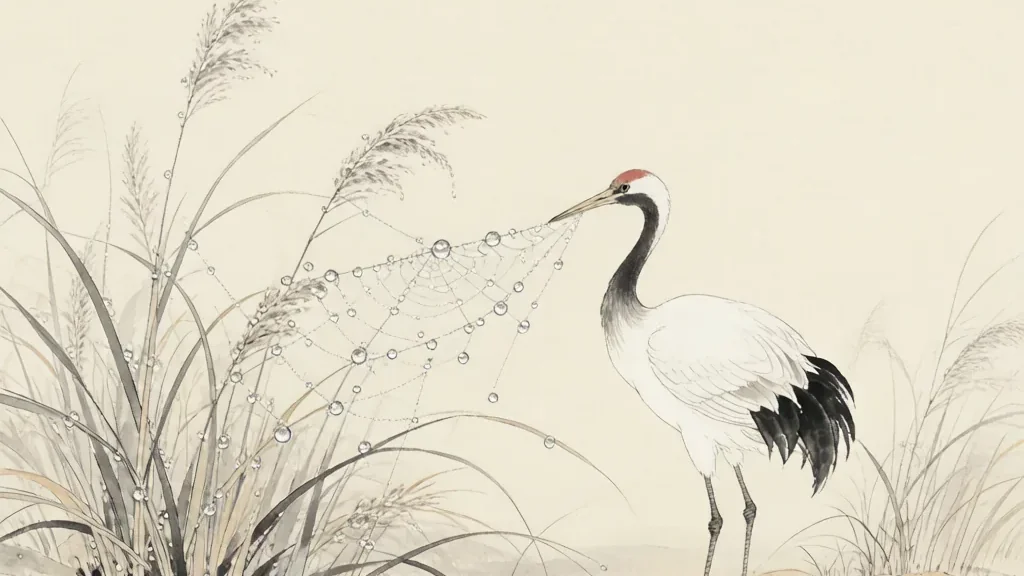
There is a morning in early September when you step outside and see the world transformed. Every blade of grass wears a crystalline droplet. Spider webs, stretched between branches, are strung with pearls. The leaves of the lotus in the pond hold small pools of water that catch the morning light. This is Bailu — White Dew — the fifteenth solar term in the Chinese calendar, arriving around September 7th or 8th. Its name captures one of autumn's most delicate phenomena: the moment when cooling night air condenses moisture into dew that gleams white in the dawn.
The Science of White Dew
The formation of dew requires specific conditions, and the ancient Chinese understood these conditions even without modern meteorological vocabulary. As autumn advances, the nights grow longer and the air cools. When the temperature drops to the dew point, water vapor in the air condenses on surfaces that have radiated their heat into the night sky — leaves, grass, stones, and spider silk. The resulting droplets are not white in themselves but appear so when they catch and scatter the early morning light.
In the Chinese five-element system, autumn is associated with the metal element and the color white. Thus "white dew" carries layers of meaning: it is literally the dew of early autumn mornings, but it is also the dew of the metal season, the moisture that marks the transition from summer's fire to autumn's metal. The term appears in classical poetry as early as the Book of Songs, China's oldest collection of poetry dating back to the 11th century BCE, where it describes the beauty of a woman whose skin is compared to "the white dew on the reeds."
Bailu marks the true end of summer's heat. The proverb "白露秋分夜,一夜凉一夜" — "From Bailu to the autumn equinox, each night is cooler than the last" — describes the inexorable cooling that follows this solar term. The autumn tiger that plagued Liqiu has retreated. Even daytime temperatures begin their decline, and the oppressive humidity of summer gives way to the crisp, dry air that characterizes the most pleasant season of the Chinese year.
The White Dew Tea Ceremony
Among tea connoisseurs, Bailu holds special significance as the season for White Dew tea (白露茶, bái lù chá). Tea leaves harvested during this period, particularly in the famous tea-growing regions of Fujian and Zhejiang provinces, are said to possess a distinctive character. The leaves have benefited from the full summer growing season but are harvested after the heat has begun to subside, resulting in a tea that is rich and full-bodied yet smoother and less astringent than summer harvests.
The tradition of drinking White Dew tea is particularly cherished in Nanjing, where old tea houses still serve this seasonal specialty. Local connoisseurs claim that tea leaves picked in the morning dew of Bailu carry the essence of autumn's clarity. The tea is brewed with water that has been collected from the previous night's dew — or, more practically in modern times, with pure spring water — and sipped slowly while appreciating the changing season.
Beyond tea, Bailu is associated with the making of rice wine in several southern provinces. In Zhejiang's rural areas, families prepare 白露米酒 (bái lù mǐ jiǔ), White Dew rice wine, using freshly harvested glutinous rice. The wine ferments through the autumn months and is ready for consumption by winter, its sweet, mild flavor a warming comfort during the cold months ahead. The tradition reflects the agricultural calendar's rhythm: harvest, preserve, and prepare for the lean season.
Harvest and Agricultural Traditions
For farmers across China, Bailu signals the acceleration of the autumn harvest. The proverb "白露满地红黄白,棉花地里人如海" — "When Bailu covers the ground in red, yellow, and white, the cotton fields are as crowded as the sea" — paints a vivid picture of the agricultural activity that defines this period. Cotton bolls burst open, revealing their white fiber. Sorghum turns deep red. Soybean plants yellow and dry. The landscape becomes a patchwork of harvest colors.
In northern China, Bailu is the critical period for harvesting summer-sown crops and preparing fields for winter wheat. The timing is precise: harvest too early and the grain is not fully mature; harvest too late and autumn rains may damage the crop. Generations of accumulated agricultural wisdom, encoded in Bailu's phenological signs, guided these decisions. When the swallows departed for the south — one of Bailu's traditional pentads — farmers knew that the weather would soon turn and the remaining harvest must be gathered quickly.
In the loess plateau regions of Shaanxi and Shanxi, Bailu marks the beginning of the jujube (red date) harvest. The jujube tree, hardy and drought-resistant, has sustained communities on the dry plateau for millennia. When Bailu arrives, entire villages turn out to harvest the fruit, spreading tarps beneath the trees and shaking the branches until the ripe dates rain down. The harvested dates are dried in the autumn sun, their sweetness concentrated for winter consumption.
The Symbolism of Dew in Chinese Culture
Dew holds a special place in Chinese cultural imagination. Unlike rain, which falls from the sky, dew materializes mysteriously from the air itself, appearing without sound or warning. In Daoist alchemy, dew was considered a pure substance, condensed from the essence of the moon and stars, and was collected for use in elixirs of immortality. Emperors commissioned the construction of special dew-collecting plates — bronze basins mounted on tall pillars — to gather this celestial moisture for medicinal and ritual purposes.
The ephemeral nature of dew also made it a powerful poetic metaphor. The phrase "人生如朝露" (rén shēng rú zhāo lù) — "human life is like morning dew" — expresses the Buddhist and Daoist understanding of life's transience. Dew appears beautiful and perfect in the morning light, but it vanishes with the rising sun. This metaphor, appearing in countless poems and philosophical texts, urges the reader to appreciate the present moment and not cling to what must inevitably pass.
In the context of Bailu, however, the dew's symbolism is more celebratory than melancholic. The appearance of white dew confirms that autumn has truly arrived, that the oppressive heat of summer is over, and that the season of harvest and abundance has begun. The dew is not a symbol of death but of transformation — the same transformation that turns green leaves gold and fills the orchards with ripening fruit.
Health Practices for White Dew Season
Traditional Chinese medicine pays close attention to Bailu as a season requiring particular health vigilance. The combination of cool mornings and warm afternoons creates conditions that can easily lead to illness. The saying "白露身不露" — "at White Dew, do not expose your body" — advises people to begin dressing more warmly, covering arms and legs that were bared during summer. The cooling air, particularly in the mornings, can enter the body through exposed skin and cause respiratory illness.
Dietary recommendations for Bailu emphasize moistening and nourishing foods. The autumn dryness that follows Bailu can irritate the lungs and skin, so traditional practitioners recommend pears, white fungus soup (银耳汤, yín ěr tāng), lily bulbs, lotus seeds, and honey. These foods, mostly white in color — corresponding to the metal element and lung system of autumn — are believed to replenish the body's yin fluids and protect against the season's drying influence.
In Fujian province, there is a unique Bailu tradition involving the longan fruit (龙眼, lóng yǎn). Local belief holds that eating longan on Bailu day provides exceptional nutritional benefits, equivalent to eating an entire chicken. While the scientific basis for this claim may be dubious, longan is indeed rich in iron and vitamins, and the tradition provides a charming example of how solar terms become associated with specific foods in regional folk culture.
As China has modernized, the practical agricultural significance of Bailu has diminished for the urban majority. But the solar term's poetic power remains undiminished. On a September morning, when the air is cool and the grass sparkles with dew, the ancient name still fits perfectly. White dew still appears, as it has for millennia, a daily miracle of condensation that marks the turning of the year.
White Dew in Classical Poetry
Few solar terms are as literary as Bailu. The phrase appears in the opening lines of the Book of Songs, China's oldest poetry collection, where reeds stand dark against white dew soon to become frost, an image of longing and the passing of time. Later Tang poets returned to the same motif, using cool dew on lotus and grass to signal the melancholy beauty of autumn. Because the term links a precise natural observation to more than two thousand years of verse, Bailu is as much a poetic marker as a meteorological one, a word that carries the weight of the whole Chinese literary tradition.
Bailu Rice Wine and Home Brewing
Beyond tea, Bailu is the season for making bai lu mi jiu, a soft rice wine fermented from freshly harvested glutinous rice. Families in Zhejiang and neighboring provinces seal the brew as the weather cools, letting it mature through the autumn so it is ready to warm the cold months. The practice belongs to the older rhythm of the farming year: harvest, preserve, and prepare for the lean season ahead. A jar started at Bailu becomes a small reserve of comfort, opened at winter gatherings to mark the turning from abundance to storage.
Phenology: Reading the Signs of Bailu
The classic almanacs divide Bailu into three five-day pentads, each with its own signal. In the first, the swallows that summered in the north fly south; in the second, the swan geese begin their long migration and the patterned geese answer with calls; in the third, birds of prey sharpen their hunting as small creatures hide from the cooling world. These observations were never mere description. They told farmers when to finish the grain and when to expect the first true cold, a folk calendar written in the behavior of birds and written so reliably that it still describes the Bailu countryside today.
❓ Frequently Asked Questions
📝 Chinese Vocabulary
- 白露 (bái lù) — White Dew; the fifteenth solar term
- 白露茶 (bái lù chá) — White Dew tea; tea harvested during this solar term
- 人生如朝露 (rén shēng rú zhāo lù) — "Human life is like morning dew"; a poetic expression of life's transience
- 白露身不露 (bái lù shēn bù lù) — "At White Dew, do not expose your body"; a health proverb
- 银耳汤 (yín ěr tāng) — White fungus soup; a traditional autumn tonic
🎉 Fun Facts
- Ancient Chinese alchemists believed that dew collected on Bailu morning had special properties and would mix it with cinnabar to create longevity elixirs for the emperor.
- The character 露 (dew) appears in the names of several famous Chinese teas, including the legendary White Dew tea and various jasmine dew teas, reflecting dew's association with purity and refinement.
- In some regions, people still practice the custom of collecting Bailu morning dew in ceramic vessels and using it to wash their eyes, believing it improves vision and prevents eye diseases.
- Bailu is the traditional time to harvest longan in Fujian, where local belief holds that eating the fruit on this single day equals the nourishment of a whole chicken.
- In northern farming regions the departure of the swallows around Bailu is read as a signal that the remaining grain must be brought in before the autumn rains arrive.
- Because the nights turn cool while the days stay warm, Bailu is also a favorite season for fermenting the glutinous-rice wine that many families serve through the winter.