More Cultural Details
This solar term has been observed in Chinese culture for thousands of years. Ancient Chinese farmers relied on these seasonal markers to plan their agricultural activities. The wisdom of the 24 solar terms was recognized by UNESCO in 2016 as an Intangible Cultural Heritage of Humanity.
During this period, traditional Chinese medicine practitioners recommend specific dietary adjustments and lifestyle changes to maintain harmony with nature. The philosophy of "yang sheng" (养生), or nurturing life, is deeply connected to the solar terms. Each term brings its own recommended foods, exercises, and daily routines.
In literature and poetry, this season has inspired countless works. Poets of the Tang and Song dynasties often used seasonal imagery to express emotions and philosophical reflections. The changing of the seasons remains a central theme in Chinese art and culture.
Modern celebrations of this solar term continue in many communities across China. Local festivals, temple fairs, and family gatherings mark the occasion. Schools often teach children about the significance of each solar term, ensuring that this ancient knowledge is passed down through generations.
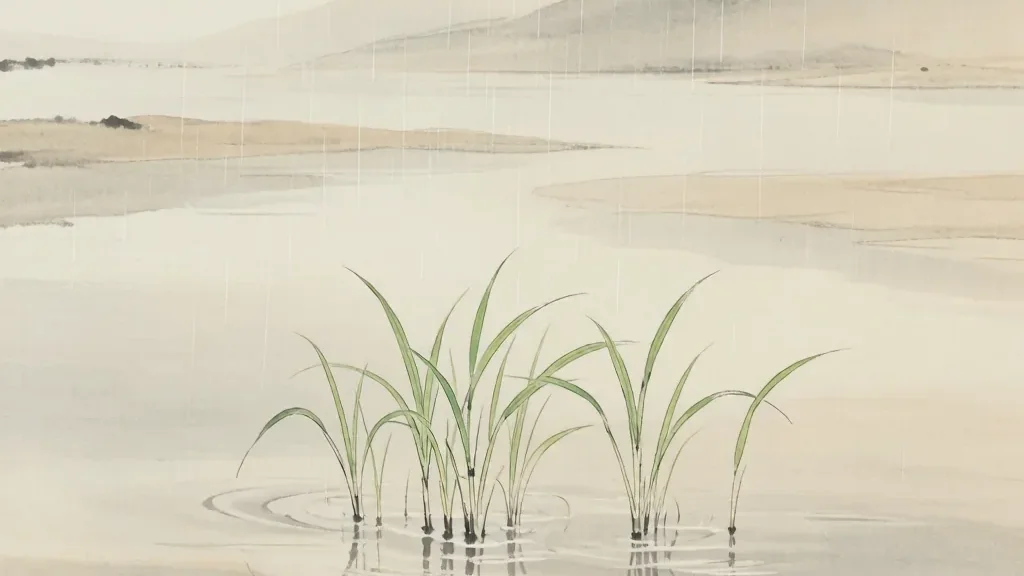
Grain Rain (谷雨, Gǔyǔ) arrives as the sixth and final solar term of spring, typically falling between April 19th and 21st. Its name carries a beautiful simplicity: 谷 (gǔ) means grain, and 雨 (yǔ) means rain — together declaring that the spring rains nourish the hundred grains. For the agricultural civilization of ancient China, this was a moment of profound gratitude, when the life-giving waters of late spring filled the swelling seeds that would become the year's harvest. The ancient saying "雨生百谷" (yǔ shēng bǎi gǔ), meaning "rain gives birth to a hundred grains," captures the essence of this season in just four characters.
When the sun reaches 30 degrees of celestial longitude, Grain Rain begins, marking a period when rainfall across China increases significantly. The warm, moisture-laden air of late spring creates ideal conditions for the final push of grain development before the heat of summer arrives. In the Yellow River basin, winter wheat enters its critical grain-filling stage, while in the Yangtze River valley, early rice seedlings stand ready for transplanting into flooded paddies. Every drop of rain during this period was seen by ancient farmers as a direct contribution to the autumn harvest, making Grain Rain one of the most agriculturally significant moments in the solar calendar.
Grain Rain Tea: The Last Spring Harvest
Among the most treasured products of the Grain Rain season is 谷雨茶 (gǔyǔ chá), or Grain Rain tea — the tea leaves picked during this brief window before the summer heat transforms their character. Connoisseurs across China consider Grain Rain tea to possess a uniquely balanced quality: it has more body and richness than the delicate early-spring teas picked before Qingming, yet retains a freshness and clarity that summer teas lack. The leaves, having absorbed weeks of gentle spring rain and mild sunshine, produce a brew that is simultaneously fragrant and substantial, with a lingering sweetness that coats the palate.
The tradition of Grain Rain tea picking is particularly strong in Zhejiang, Fujian, and Anhui provinces, where generations of tea farmers have perfected the art of identifying the optimal picking moment. Tea pickers rise before dawn during this season, climbing misty hillsides to pluck the tender "one bud, one leaf" or "one bud, two leaves" sets that yield the finest quality. The morning dew still clings to the leaves as they are gathered into bamboo baskets, and the processing must begin within hours to capture the leaves' peak freshness. The resulting tea — whether green, white, or lightly oxidized oolong — carries the essence of late spring in every cup.
In Chinese tea culture, Grain Rain tea holds special significance beyond its flavor. The legendary figure Shennong, the Divine Farmer who according to myth discovered tea's medicinal properties, is said to have first tasted tea leaves during the Grain Rain season. This connection has made Grain Rain tea a symbol of health and vitality, and many families maintain the tradition of drinking freshly picked Grain Rain tea as a spring tonic. Modern research has confirmed what traditional wisdom long held: spring-harvested tea contains higher levels of antioxidants and amino acids than later harvests, making it particularly beneficial for clearing the body of winter's accumulated sluggishness.
The Peony Festival: Flowers of Wealth and Honor
Grain Rain coincides with the spectacular blooming of the peony (牡丹, mǔdān), China's most beloved flower and a symbol of wealth, honor, and feminine beauty. The relationship between the peony and Grain Rain is so intimate that the flower is sometimes called 谷雨花 (gǔyǔ huā) — the "Grain Rain flower." Across China, but especially in the ancient capitals of Luoyang and Heze, this season brings a explosion of color as thousands of peony varieties unfurl their massive, multi-layered blossoms in shades of pink, red, white, yellow, and purple.
The peony's association with Grain Rain runs deep in Chinese cultural history. During the Tang Dynasty, when the peony reached the height of its popularity as an imperial favorite, the capital city of Chang'an (modern Xi'an) would transform into a city of flowers during this season. Emperors and aristocrats held lavish peony-viewing parties, poets composed verses celebrating the flower's magnificence, and artists captured its image in paintings and on ceramics. The Tang poet Liu Yuxi famously wrote, "Only the peony is truly the national beauty; when it blooms, the whole capital is stirred" — a testament to the flower's enduring hold on the Chinese imagination.
Today, the tradition of peony appreciation during Grain Rain continues vibrantly. The Luoyang Peony Festival, held annually during this period, draws millions of visitors to view gardens containing thousands of peony varieties. The flowers are not merely admired for their beauty; they carry layers of cultural meaning. The peony represents prosperity and high social status, and displaying peonies in one's home during Grain Rain is believed to attract good fortune. Peony motifs appear on everything from porcelain vases to embroidered silk, and the flower remains one of the most popular subjects in Chinese painting. In traditional medicine, peony root bark (牡丹皮, mǔdān pí) is valued for its cooling and blood-moving properties.
Honoring Cang Jie: The Creator of Chinese Characters
Grain Rain carries a unique cultural significance as the traditional day for honoring Cang Jie (仓颉), the legendary figure credited with inventing Chinese characters. According to ancient mythology, Cang Jie served as the official historian of the Yellow Emperor and was tasked with developing a system for recording information. Inspired by the patterns of bird tracks in the sand, animal footprints in the earth, and the shapes of stars in the night sky, Cang Jie created the first set of Chinese characters — a momentous achievement that, according to legend, caused the heavens to rain grain and the spirits to wail in recognition of the profound power humans had gained through writing.
The story of Cang Jie's invention connects directly to the name and character of Grain Rain. The myth states that when Cang Jie presented his creation to the Yellow Emperor, the heavens responded by showering the earth with grain instead of rain — a divine acknowledgment that the invention of writing was as nourishing to civilization as rain was to crops. This celestial grain shower is said to have occurred on the day we now celebrate as Grain Rain, and the tradition of honoring Cang Jie on this day has persisted for millennia. In Cang Jie's hometown in Shaanxi Province, a temple dedicated to him draws pilgrims during Grain Rain who come to pay respects to the father of Chinese writing.
The Cang Jie commemoration during Grain Rain serves as a powerful reminder of the deep connection between Chinese civilization and its writing system. Unlike alphabetic scripts, Chinese characters preserve visual and semantic connections to the natural world that inspired their creation. Each character is a small work of art, encoding observations of nature that stretch back thousands of years. During Grain Rain, calligraphers and scholars sometimes perform public demonstrations, writing characters with brush and ink as an homage to Cang Jie's legacy. The celebration of writing during the season of nourishing rain beautifully links two forms of cultivation — the agricultural and the intellectual — that together formed the foundation of Chinese civilization.
Eating Chinese Toon and Seasonal Delicacies
Grain Rain brings a brief but eagerly anticipated culinary window: the season for Chinese toon (香椿, xiāngchūn), the tender young leaves and shoots of the Chinese mahogany tree. These reddish-purple sprouts, with their distinctive aromatic flavor — somewhere between onion, garlic, and a unique nuttiness — are available for only a few weeks in late spring. The saying "雨前香椿嫩如丝" (yǔ qián xiāngchūn nèn rú sī) declares that "before the Grain Rain, toon shoots are as tender as silk," but after the rains, they grow woody and lose their prized flavor.
The simplest and most beloved preparation is scrambled eggs with toon (香椿炒鸡蛋, xiāngchūn chǎo jīdàn), a dish that allows the toon's unique fragrance to shine. The chopped shoots are briefly blanched to soften their intensity, then stirred into beaten eggs and gently cooked until just set. Other classic preparations include toon mixed with fresh tofu, toon pancakes, and toon preserved in salt as a condiment to extend its short season. In Beijing and Shandong cuisine, toon is sometimes battered and deep-fried as a spring delicacy, its crispy exterior giving way to a tender, fragrant interior.
Beyond toon, Grain Rain cuisine emphasizes foods that help the body transition from spring to summer. Fresh bamboo shoots, still tender from their rapid spring growth, feature prominently in southern Chinese cooking. Wild herbs and greens — shepherd's purse, dandelion, and young bracken — are gathered and prepared in simple dishes that celebrate their natural flavors. In coastal regions, the spring fishing season begins in earnest during Grain Rain, bringing fresh catches of yellow croaker, pomfret, and shrimp to local markets. The seasonal emphasis is on lightness and freshness, preparing the body's digestive system for the heavier, more cooling foods that summer will require.
Agricultural Significance and Health Wisdom
For Chinese farmers, Grain Rain represents one of the year's busiest and most critical agricultural windows. The saying "谷雨前后,种瓜点豆" (gǔyǔ qián hòu, zhòng guā diǎn dòu) — "around Grain Rain, plant melons and sow beans" — guided planting decisions across the country. Cotton, peanuts, soybeans, and sweet potatoes all found their way into the warming soil during this period. In the rice-growing south, Grain Rain marked the optimal time for transplanting rice seedlings from nursery beds to flooded paddies, a back-breaking but essential task that would determine the year's rice harvest.
The agricultural activities of Grain Rain were often accompanied by community rituals and observances. In coastal fishing communities of Shandong and Zhejiang, fishermen held ceremonies to honor the sea gods and pray for a safe and bountiful fishing season. The "Grain Rain Festival" in some fishing villages involved elaborate offerings, dragon dances, and the blessing of boats before they set out to sea. These rituals acknowledged the dangerous nature of the fishermen's work and sought divine protection for those who would spend the coming months on the water.
Traditional Chinese medicine offers specific guidance for the Grain Rain period, when the body must adapt to rising temperatures and increasing humidity. The spleen and stomach are considered particularly vulnerable to the dampness that characterizes late spring weather. Practitioners recommend foods that support the spleen's transforming function: Chinese yam, coix seed (Job's tears), lotus seeds, and poria mushroom. Bitter greens and chrysanthemum tea help clear heat that may begin to accumulate as summer approaches. Gentle outdoor exercise — walking, tai chi, or gardening — helps circulate qi and blood, while the traditional advice to "cover the body in spring" (春捂, chūn wù) reminds people not to shed warm clothing too quickly despite rising temperatures. This holistic approach to seasonal living represents the accumulated health wisdom of countless generations attuned to nature's rhythms.
Weather Patterns Across the Regions
Grain Rain brings the year's most noticeable jump in rainfall, but the way that rain arrives differs sharply by region. In the Yellow River basin, late-spring showers soak the wheat fields during their final grain-filling stage. In the Yangtze River valley the season's humidity climbs and the plum rains may already be building, while in the far south paddy fields are flooded for rice transplanting. Northern areas can still see cool, dry spells between storms, so farmers watch the sky as much as the calendar. The saying that rain during Grain Rain feeds a hundred grains reflects a simple agricultural truth: at this moment, water equals yield. Because the term sits at the very end of spring, a late cold snap or a missed rain can threaten both the wheat harvest and the young rice, making regional weather the single most important variable of the season.
Grain Rain in Classical Poetry
Chinese poets have long treated the spring rains of Grain Rain as a symbol of renewal, gratitude, and quiet beauty. Tang and Song writers frequently pictured the soft late-spring drizzle falling on newly planted fields, on the unfolding peonies, and on the thatched roofs of village homes. The season's tea and peonies appear again and again as images of refinement and fleeting pleasure, reminders that the abundance of late spring will soon give way to summer's heat. For scholar-officials far from home, the grain rain could also stir longing, since it marked the moment when the rural world turned busiest even as the gentleman sat idle. These poems helped fix Grain Rain in the cultural imagination not merely as a farming date but as a mood, a sensory moment of mist, fragrance, and the sound of water on leaves.
❓ Frequently Asked Questions
📝 Chinese Vocabulary
- 谷雨 (gǔ yǔ) — Grain Rain; the sixth and final solar term of spring
- 谷雨茶 (gǔ yǔ chá) — Grain Rain tea; prized tea leaves picked during this season
- 牡丹 (mǔ dān) — Peony; China's national flower, which blooms during Grain Rain
- 香椿 (xiāng chūn) — Chinese toon; tender aromatic shoots eaten as a spring delicacy
- 仓颉 (Cāng Jié) — Cang Jie; the legendary inventor of Chinese characters, honored during Grain Rain
🎉 Fun Facts
- Grain Rain tea is often called "rain-before tea" and is prized for its fuller body compared to the delicate pre-Qingming teas, making it a favorite among experienced tea drinkers.
- The peony is known as the "King of Flowers" in Chinese culture, and during the Tang Dynasty, peonies were so highly valued that individual plants could cost as much as a family home.
- According to legend, when Cang Jie invented Chinese characters, millet rained from the sky — hence the name "Grain Rain" and the tradition of honoring the written word during this season.
- Chinese toon shoots contain compounds that give them their unique flavor and have been studied for their antioxidant and anti-inflammatory properties.
- The cuckoo, called the bugu bird in Chinese because its call sounds like 'plant grain, plant grain,' becomes especially vocal during Grain Rain and was long treated by farmers as a natural signal to hurry spring planting.
- Grain Rain marks the traditional deadline for transplanting rice seedlings in the Yangtze River region; missing this window was believed to shorten the growing season and reduce the autumn yield.