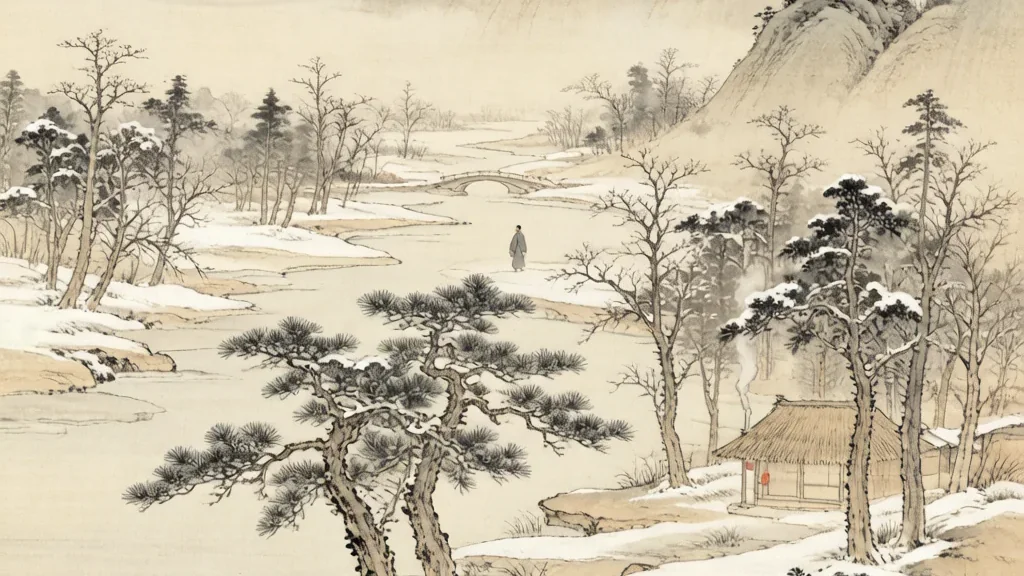
Dahan, or "Major Cold" (大寒), is the twenty-fourth and final solar term in the traditional Chinese calendar, usually arriving around January 20. It marks the deepest point of winter cold before the cycle turns again toward spring. When the sun reaches the ecliptic longitude of 300 degrees, northern China often experiences its lowest temperatures of the year, with frozen rivers, bare fields, and biting winds. Yet Dahan is also a term of preparation and quiet hope: it sits just before Lichun, the Beginning of Spring, and in the agricultural mindset it represented the last stretch of rest before the coming year's labor. The name itself—da meaning great or major, and han meaning cold—captures both the harshness of the season and its significance as a boundary in the annual round.
Position in the Solar Term Cycle
Dahan closes the wheel of twenty-four terms. It follows Xiaohan (Minor Cold) and precedes Lichun (Beginning of Spring). Because the terms are anchored to the sun's position rather than to fixed weather, Dahan does not always bring the absolute coldest days everywhere, but in much of northern China it coincides with the heart of winter.
The pairing of Xiaohan and Dahan reflects the Chinese habit of grading intensity: "minor" cold gives way to "major" cold, much as Minor Heat and Major Heat mark summer's peak. After Dahan, the logic of the system promises relief, since the very next term is the first whisper of spring.
Weather and the Coldest Days
In the North China Plain and the Northeast, Dahan often brings the year's lowest temperatures, sometimes far below freezing, with the ground locked hard and lakes frozen solid. The phrase "Major Cold, freezing to the bone" (大寒大冷) conveys the popular experience of the term.
Southern China is milder but still damp and chilly, the kind of cold that penetrates clothing. Folk observation held that if Dahan was not especially cold, the following spring might arrive with damaging late frosts—an example of how weather at the term's edge was read as a portent for the season ahead.
Farming During the Deep Cold
With fields frozen and little to plant or harvest, Dahan was a comparatively quiet agricultural period in the north. Farmers mended tools, repaired granaries, and tended livestock kept close for warmth. The work was preparatory rather than active cultivation.
In warmer southern regions, some winter vegetables and wheat still required care, and orchards were pruned during dormancy. The term's calm gave farming households time to settle accounts, plan the coming year's crops, and rest—a necessary pause before the demanding spring tasks began.
Food and Warming Customs
Dahan cuisine centered on warmth and nourishment. In many northern homes, people ate mutton, beef, and rich broths believed to build resistance to cold. A popular dish in some regions was "stewed soup" shared among family to keep everyone hale through winter.
The habit of eating foods that "warm the body" (温补) reflected traditional Chinese dietary theory, which matched foods to seasons. Along the coast and in the south, preserved meats and hearty congees featured prominently. These dishes were both practical protection against cold and expressions of household care.
The Custom of "Beating Spring" and Year-End Rites
Because Dahan borders the Lunar New Year season in many years, it overlapped with year-end cleaning, ancestral offerings, and preparations for Spring Festival. In some localities, ceremonies anticipating Lichun—such as making a clay "spring ox" to be beaten—began during Dahan.
This "beating the spring ox" (打春) ritual, more properly tied to Lichun, symbolized urging the fields back to life. During Dahan, communities sometimes staged rehearsals or crafted the ox, blending the close of winter with hopeful anticipation of renewal just around the corner.
Scientific and Health Traditions
Traditional health advice for Dahan stressed protecting the body's warmth, especially the head, feet, and lower back, and avoiding sudden exposure to cold. Moderate activity indoors and a calm routine were recommended to conserve energy.
The term also warned against overindulgence during the nearby New Year feasts, balancing celebration with restraint. Such guidance, recorded in almanacs and household manuals, treated Dahan as a time to husband strength for the busy year to come.
Literary and Cultural Meanings
Poets used Dahan to evoke endurance and the promise of return. The image of plum branches blooming against ice became a symbol of resilience, since certain winter plums flower precisely in deep cold. Scholar-officials contrasted the world's stillness with the inner vitality gathering beneath it.
In painting and decoration, the "three friends of winter"—pine, bamboo, and plum—were favorite Dahan motifs, celebrating plants that thrive when others wither. These associations gave the coldest term a surprisingly warm cultural resonance.
Dahan Today
In contemporary China, Dahan appears on calendars and weather reports as a seasonal marker rather than a festival with large public rites. Yet its foods, health sayings, and plum-blossom imagery remain familiar, especially in almanac apps and seasonal articles.
As climate awareness grows, Dahan also serves as a reminder of natural cycles and the value of rest within them. For many, noticing the term is a small way to stay connected to the rhythm that once governed daily life across the land.
From Dahan to a New Cycle
Dahan's deepest meaning is that it is an ending that is also a threshold. Immediately after it comes Lichun, and with it the whole sequence begins anew. The cold is not a dead end but the still point before movement returns.
This framing taught patience: the harshest moment carries the seed of reversal. Understanding Dahan helps one appreciate why the solar terms were not merely weather notes but a philosophy of change, balance, and renewal woven into the Chinese year.
Regional Variations of Dahan
Although Dahan is a single point on the solar-term calendar, the way it was experienced differed sharply across China's vast geography. In the frigid Northeast, the term meant weeks of sub-zero cold, ice fishing, and households huddled around heated kang platforms; in the subtropical south, Dahan might bring merely a cool, damp spell in which mustard greens and winter vegetables still grew in the fields.
These regional contrasts produced different customs. Northerners emphasized indoor warmth, preserved foods, and communal winter pastimes, while southern communities could still tend orchards and early crops. Coastal areas faced cold winds off the sea, and mountain villages contended with snowbound isolation that made the term a test of storage and preparation.
Such variety reminds us that the solar terms describe a normative national pattern layered over intensely local weather. The almanac named the moment; the lived experience of Dahan was shaped by the rivers, hills, and winds of each place, a unity of calendar and diversity of climate that the system accommodated rather than erased.
❓ Frequently Asked Questions
When does Dahan occur?
Dahan usually arrives around January 20, when the sun reaches 300° of ecliptic longitude.
Is Dahan the coldest solar term?
In much of northern China it brings the year's lowest temperatures, though exact cold days vary by region and year.
What comes after Dahan?
The very next term is Lichun, the Beginning of Spring, starting a new annual cycle.
What foods are eaten at Dahan?
Warming dishes such as mutton, beef broth, and hearty congees are traditional, following the idea of "warming nourishment."
Why are plums associated with Dahan?
Certain winter plums bloom in deep cold, making them symbols of endurance celebrated in poetry and art.
How is Dahan observed today?
Mostly as a calendar and weather marker, with its foods, health sayings, and plum imagery still familiar in almanacs and apps.