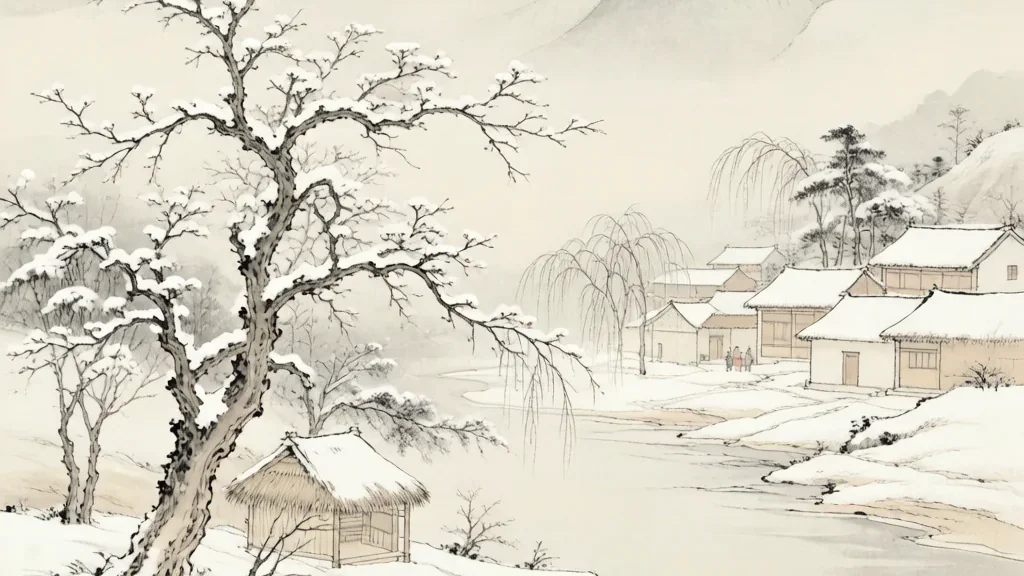
Daxue, "Greater Snow," is the twenty-first of the twenty-four traditional Chinese solar terms and usually begins around December 7. It follows Xiaoxue (Lesser Snow) and precedes Dongzhi (Winter Solstice) in the winter calendar. As the name suggests, Daxue is the time when snow becomes heavier and more frequent across northern China, and the cold reaches its most severe before the solstice. The term is less a guarantee of snow than a marker of the season's depth: rivers freeze, the land lies under a hush of white in the north, and households settle into the routines of deep winter, relying on the stores laid in during autumn.
Depth of the Winter Calendar
Daxue is the third solar term of winter, following Xiaoxue and preceding Dongzhi. The sun reaches a celestial longitude of 255 degrees at its start. In the traditional sequence, it is the point where winter's cold is fully established rather than just beginning.
For farmers, Daxue means the fields are at rest. There is little outdoor work except protection of winter crops and livestock. The term's quiet is the quiet of a landscape paused, waiting out the cold until the light begins to return at the solstice.
The Three Pentads of Daxue
Daxue's pentads describe the frozen world. The first is "the magpie builds its nest" (que shi bu chao), as birds prepare shelter. The second is "the pheasant stops calling" (ti hou bu ming), the bird falling silent in the cold. The third is "the closed pools freeze" (bi se cheng dong), as ponds and streams ice over.
These signs show a world buttoned up against the cold. The building nest and the silent bird and the frozen water together describe a season of stillness and preparation, where life continues quietly beneath the surface.
Snowfall Across the Regions
In northern China, Daxue often brings the season's heaviest snows, covering the plains and weighting the branches. The snow protects winter wheat by insulating the soil, and the saying that "a timely snow promises a good harvest" (rui xue zhao feng nian) values it as a blessing.
In the south, Daxue may bring only cold rain or light snow, and in the far south none at all. The term's name describes a northern norm; local experience varies widely, and farmers read their own snowfall as the real omen rather than the calendar's label.
The Blessing of Timely Snow
The proverb "auspicious snow promises a fertile year" reflects a real agricultural logic. Snow insulates the ground, preventing the freeze-thaw that harms roots; its meltwater in spring irrigates the fields; and the cold suppresses pests and disease overwintering in the soil.
This positive view of snow runs deep in Chinese culture. Rather than a hardship, a good Daxue snowfall is welcomed as insurance for the coming year — a gift of water stored in frozen form, to be released when the crops need it most.
Winter Wheat and Protection
In the north, winter wheat planted in autumn now lies dormant under snow. The crop's survival depends on the snow cover and on temperatures that, while cold, do not plunge so low as to kill the crowns. Farmers check windbreaks and drainage to protect the fields.
In milder regions, the wheat may still be green, and a hard freeze without snow cover is a danger. Daxue is therefore a term of quiet monitoring: the harvest is months away, but its fate is being decided now by cold, cover, and luck.
Food and Warming the Body
Daxue is a time for warming, nourishing food. In the north, lamb and beef hot pots, ginger dishes, and rich broths are traditional, believed to build the body's resistance to cold. In the south, tonic soups with herbs are favored.
Traditional dietary thought holds that winter is for storage and conservation, so meals turn hearty and warming. The term's food is not festive like the New Year's but practical — fuel for the body during the year's coldest, darkest stretch.
Preserved Foods and Storage
By Daxue, the preserving work begun at Xiaoxue is complete. The cured meats, dried fish, and stored vegetables from autumn now feed the household. The term is thus a culmination of the autumn's labor of storage.
In rural homes, the sight of the cellar and rafters full of preserved food was a source of security. Daxue tested that security: with little fresh produce available, the family depended entirely on what had been put by, making the term a quiet measure of the year's success.
Customs and Rest
Daxue is not a major festival term, but it is observed through rest and home life. In some places, the cold was a time for mending tools, telling stories, and gathering the family. The shortened days naturally turned attention inward.
Certain regions held small rites for the kitchen god or ancestors as winter deepened, asking for protection through the hardest months. These observances were modest compared to the great festivals, suited to a season of conservation rather than celebration.
Daxue in Modern Life
Today Daxue is noted through weather and food. News of the first heavy snow fills social media; hot pot restaurants do brisk business; and the term appears in calendars as a marker of winter's peak. For most, it is a cue to dress warmly.
Its older meaning — that snow is a blessing, that storage is security, that rest is part of the year's work — remains a useful counterweight to a culture that prizes constant activity. Daxue asks only that we endure, conserve, and wait for the light.
❓ Frequently Asked Questions
When does Daxue occur?
Daxue usually begins around December 7, when the sun reaches a celestial longitude of 255 degrees.
Does it always snow heavily at Daxue?
In the north, yes often; but the south may see only cold rain, and the far south little or none.
Why is snow considered lucky?
Snow insulates crops, irrigates in spring, and kills overwintering pests, so it promises a good harvest.
What are Daxue's three pentads?
They are the magpie building its nest, the pheasant falling silent, and the pools freezing over.
What foods are eaten at Daxue?
Warming hot pots, ginger dishes, and tonic soups are traditional to build resistance to cold.
What does Daxue mean for farmers?
Fields rest under snow; the work is protecting winter wheat and relying on stored autumn provisions.