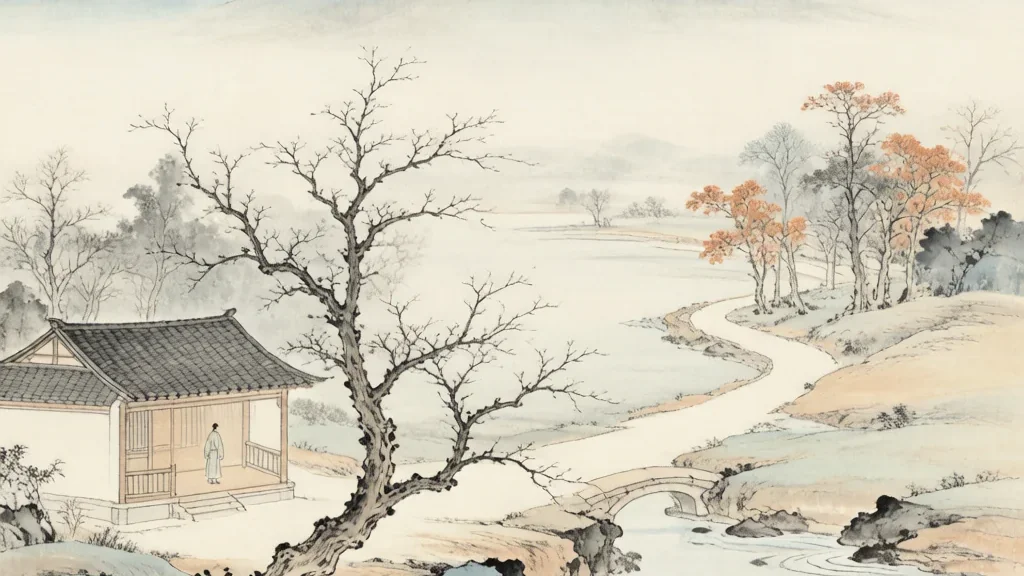
Lidong, or "Beginning of Winter" (立冬), is the nineteenth solar term and the first of the winter season in the traditional Chinese calendar, typically arriving around November 7 or 8. When the sun reaches the ecliptic longitude of 225 degrees, the harvest is largely in and the natural world prepares for dormancy. The name joins li (to begin, to stand) and dong (winter), signifying that winter "stands up" to take its place in the year. For agrarian China, Lidong was a pivotal marker: it was the moment to store the grain, settle the year's accounts, and honor the shift from outward labor to inward rest. Though not as elaborately celebrated as the Winter Solstice, Lidong carried deep cultural weight as the threshold of the cold, dark half of the year.
Calendar Position and Meaning
Lidong belongs to the quartet of "beginning" terms that open each season. It follows the autumn term Shuangjiang (Frost's Descent) and precedes Xiaoxue (Minor Snow). Astronomically it is fixed by the sun's position at 225° of ecliptic longitude.
Culturally, Lidong expressed the philosophy of rest after work. Just as a day's labor ends at dusk, the year's fieldwork ended at winter's start. Households turned from the fields to the hearth, and the term sanctioned a slower pace justified by the season itself.
Harvest Closing and Storage
By Lidong, the autumn harvest of rice, corn, sorghum, and beans was generally complete across most of China. The urgent task became storage: drying grain, sealing it against moisture and vermin, and stacking firewood for the cold months.
Farmers also saw to the land's rest, sometimes plowing stubble back in or spreading manure to nourish fields lying fallow. The term thus combined closure—finishing the year's work—with quiet preparation for the next, a rhythm of action and pause.
The Tradition of "Winter Nourishing"
A core Lidong custom was bu dong (补冬), "nourishing the winter," the belief that the body should be fortified with rich foods as cold set in. Families prepared meats, especially pork, chicken, and duck, often simmered with herbs into restorative soups.
In the south, people favored jiang ya (salt-cured duck) and other preserved specialties; in the north, mutton and dumplings were common. The practice reflected the traditional medical idea that winter is the time to conserve and build the body's reserves.
Dumplings and Regional Foods
In northern China, eating dumplings (饺子) at Lidong was widespread, tied to the saying that the term's cold would crack ears if not "plugged" with the ear-shaped morsels. The custom blended humor with real comfort food against the chill.
Southern regions preferred different tonics: in Fujian and Taiwan, dong ji (winter lightning) dishes using medicinal herbs and sesame oil were traditional. Such regional variety shows how one term inspired locally adapted tables across the country.
Imperial and Community Rites
In imperial times, Lidong was observed with state ceremonies welcoming winter, paralleling the summer welcome at Lixia. The emperor and officials dressed in black or dark robes—colors associated with winter in the five-phase system—and offered sacrifices to the season's deities.
Local communities, meanwhile, honored ancestors and the hearth, thanking them for the harvest and asking protection through the hard months. These rites reinforced social bonds at the moment the year turned inward.
Weather Lore and Proverbs
Many proverbs linked Lidong's weather to the winter ahead. "If Lidong is clear, the winter will be cold" and various rhymes about wind direction guided rural expectations, though they were folk wisdom rather than precise forecasts.
Observers also watched for the first freeze and the behavior of hibernating creatures. Such lore gave communities a shared way to read the season's onset and to decide how urgently to finish winter preparations.
Nature's Signs at Lidong
The classical three pentads of Lidong describe water beginning to freeze, the ground starting to harden, and pheasants fading from view while large clams appear—an ancient, symbolic mapping of the season's changes rather than literal biology.
The bare trees, retreating insects, and shortening days made the term's message visible everywhere. For farmers, these signs confirmed that the time for outdoor work had passed and the season of storage had truly begun.
Lidong in Modern Life
Today Lidong is best known through food customs and calendar apps. Restaurants and home cooks still mark it with nourishing meals, and wellness media repeat the "tonify in winter" advice, keeping the term's spirit alive in cities.
Some regions host Lidong food festivals celebrating local winter dishes, linking heritage with tourism. While few now store grain or perform state rites, the term remains a gentle annual cue to slow down and care for oneself as the year darkens.
Lidong and the Winter Arc
Lidong opens the winter sequence that runs through Xiaoxue, Daxue, Dongzhi, Xiaohan, and Dahan. Each later term deepens cold and stillness, culminating in the great cold before spring returns.
Seeing Lidong as the gateway helps explain the season's logic: it is the deliberate pause after harvest, the moment when conservation begins. The solar terms thus framed winter not as emptiness but as necessary rest within the year's larger balance.
Lidong Proverbs and the Farmer's Calendar
A rich body of proverbs grew around Lidong, encoding practical wisdom for the season's start. Sayings linked the term's weather to the winter ahead, advised on the timing of storage, and reminded households that the harvest's end was the moment to count blessings and plan anew.
Many such aphorisms paired Lidong with the terms that followed, building a narrative of the cold months: after the beginning of winter came snow, then the solstice, then the deepening cold. Farmers used this sequence as a mental calendar, knowing which task belonged to which interval of the dark season.
The proverbs also reveal a philosophical stance: winter was not feared but accepted as necessary. Lidong taught that rest, like work, had its proper time, and that a household which stored well and ate well would emerge strong when spring returned. This calm acceptance of seasonal rhythm is among the term's enduring lessons.
❓ Frequently Asked Questions
When does Lidong occur?
Lidong typically falls around November 7 or 8, when the sun reaches 225° of ecliptic longitude.
What does Lidong mean?
It combines li (begin) and dong (winter), so it means "Beginning of Winter."
Why do people eat dumplings at Lidong?
A northern custom holds that ear-shaped dumplings "plug" the ears against the cold; they are also simply warming comfort food.
What is "nourishing the winter"?
It is the practice of eating fortifying meats and herbal soups at Lidong to build the body's reserves for cold months.
How did farmers use Lidong?
It marked the close of harvest and the start of grain storage, firewood gathering, and a slower pace of life.
Is Lidong the same as the Winter Solstice?
No. Lidong begins winter around early November; Dongzhi, the Winter Solstice, comes about six weeks later near December 21.