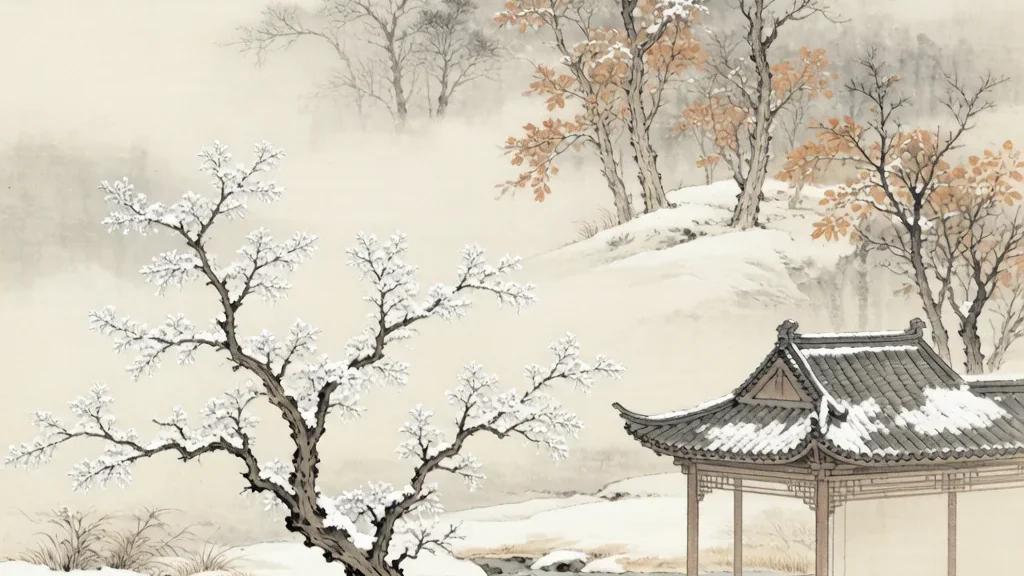
Xiaoxue, or "Lesser Snow," is the twentieth of the twenty-four traditional Chinese solar terms and usually arrives around November 22. Despite its name, Xiaoxue does not necessarily bring snow; rather, it marks the point at which the cold deepens and the northern regions begin to see their first light snowfalls, while the south may still feel only a sharp drop in temperature. The term belongs to the winter sequence that opens with Lidong (Beginning of Winter) and continues toward the heavier snows of Daxue. In the agricultural rhythm, Xiaoxue is a closing signal: the fields lie fallow, the harvest is in, and households turn to preserving food, mending clothes, and preparing for the deep cold ahead.
Place in the Winter Calendar
Xiaoxue sits as the second solar term of winter, following Lidong and preceding Daxue (Greater Snow). The sun reaches a celestial longitude of 240 degrees at its start. In the traditional view, this is when the yang energy retreats fully underground and yin dominates the surface world.
For farmers, the arrival of Xiaoxue meant the year's fieldwork was essentially finished. With the grain stored and the vegetables pulled, attention shifted indoors. The term thus functions as a hinge between the outward labor of the growing season and the inward, domestic life of winter.
The Three Pentads of Xiaoxue
Xiaoxue's three pentads describe the visible withdrawal of warmth. The first is "the rainbow hides and is not seen" (hong cang bu jian), because with cold and dry air, the conditions for rainbows no longer form. The second is "heaven's qi rises and earth's qi descends" (tian qi sheng, di qi jiang), a cosmological way of saying the two life-giving energies separate.
The third pentad is "closure and so winter forms" (bi se er cheng dong). The separation of heaven and earth qi causes the world to seal up; rivers slow, insects vanish, and the season of stillness settles in. These images gave people a poetic yet practical map of the changing atmosphere.
First Snows and Regional Difference
In northern China, Xiaoxue often brings the season's earliest snow, though usually only a dusting. The landscape turns from brown to white, and the rivers begin to ice at the edges. In the Yangtze valley, the term may arrive with cold rain rather than snow, and the first true snows might wait until Daxue or later.
Further south, in Guangdong and Yunnan, Xiaoxue can feel merely cool, with no snow at all. This regional variation is why the term is called "lesser" snow — it names a tendency of the season, not a guaranteed weather event, and reminds us that the solar terms describe a northern-China baseline climate.
Curing and Preserving Meat
The most widespread Xiaoxue custom is preserving food for winter. With temperatures dropping but not yet freezing hard, it was the ideal time to salt and air-cure pork and poultry into what are known as "cured winter meats" (dong la rou). The cold, dry air inhibited spoilage, and the preserved meat would sustain families through the lean months.
In many villages the sight of hanging cured legs and sausages became a signature of the season. The practice also had a festive side: the work of curing was communal and anticipated the richer eating of the New Year, when the preserved foods would be brought down and cooked for guests.
Eating Ciba and Other Staples
In parts of the south, especially among communities in Hunan and neighboring regions, Xiaoxue is associated with eating ciba — glutinous rice pounded into a soft, chewy cake. Served plain or with sugar, soy, or crushed peanuts, ciba is warming and filling, suited to the cold.
Other seasonal foods include root vegetables stored from autumn and hearty broths. The dietary logic of Xiaoxue favors warmth and density: the body, in traditional thinking, needs to conserve energy as the external world grows cold, so meals turn from the light greens of autumn to the substantial starches of winter.
Drying Fish and Coastal Customs
Along the southeastern coast, Xiaoxue was a time to dry fish (shai yu). As the catch came in and the air turned cool and breezy, fishermen and their families laid fish out on racks to cure in the wind. The preserved fish joined the cured meats as winter provisions and trade goods.
This coastal dimension of Xiaoxue shows how the same term supported different livelihoods. Inland it meant meat and rice cakes; by the sea it meant dried fish. Both reflected the same principle — use the cooling, drying weather to lock in food before the hardest part of winter.
Domestic Preparation for Deep Cold
Xiaoxue was also a time of household repair. Families checked their roofs, stuffed gaps in doors and windows, and made or mended winter clothing. In colder regions, the preparation of the kang (a heated brick bed) or the stocking of fuel for the stove was a serious task begun in earnest at this term.
The term's quiet domesticity is part of its character. Unlike the noisy festivals of harvest or New Year, Xiaoxue is observed mostly in small, private acts of readiness — a fitting mood for a season whose first snow falls softly and without announcement.
Folk Beliefs and Omens
As with other terms, Xiaoxue carried weather lore. A saying holds that if Xiaoxue arrives with snow, the coming spring will be free of pests and the year's crops blessed; a dry, snowless Xiaoxue, by contrast, was sometimes read as a portent of a hard winter. Such beliefs gave the weather moral and agricultural weight.
Temples and household altars might receive extra offerings at the term's start, asking for protection through the cold and a safe passage to spring. These rites blended gratitude for the stored harvest with anxiety about the months still to come.
Xiaoxue in Contemporary Culture
Today Xiaoxue is marked less by farming than by food and sentiment. Social media fills with photos of the first snow and of cured meats hanging in alleyways. Restaurants promote ciba and hot pots, and the term appears in poetry readings and seasonal artwork.
For city dwellers far from the land, Xiaoxue offers a gentle, shared moment to notice the season — to watch the first snow, to eat something warm, and to acknowledge, as the old calendar intended, that nature has closed its doors and invited us to rest.
❓ Frequently Asked Questions
When does Xiaoxue occur?
Xiaoxue usually begins around November 22, when the sun reaches a celestial longitude of 240 degrees.
Does it snow during Xiaoxue?
Not always; the term names the season's first light snows in the north, while the south may only get colder rain.
What foods are linked to Xiaoxue?
Cured pork, dried fish, and glutinous rice cakes (ciba) are traditional foods preserved or eaten at this term.
What are the three pentads of Xiaoxue?
They are the hidden rainbow, the rising of heaven's qi and descent of earth's qi, and the closure that forms winter.
Why is Xiaoxue a time for preserving food?
The cool, dry air inhibits spoilage, making it ideal to cure meat and fish before the deep freeze of mid-winter.
How is Xiaoxue observed now?
Mostly through seasonal eating, the sight of first snow, and cultural posts, rather than farming rituals.