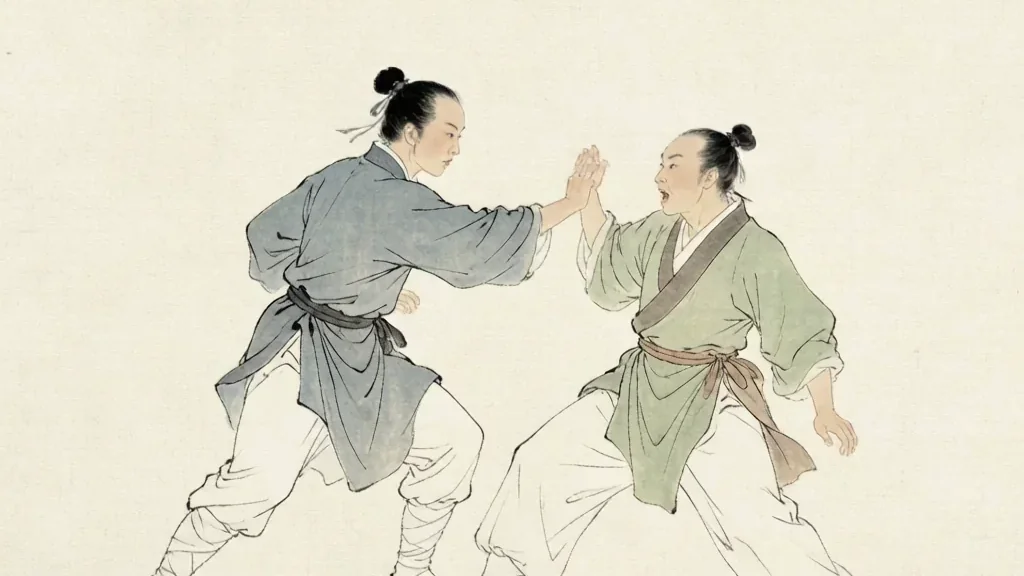
In the landscape of Chinese martial arts, few styles have achieved the global recognition of Wing Chun (咏春拳). Known for its devastating close-range techniques, economy of motion, and scientific approach to combat, Wing Chun traces its roots to the turbulent world of 17th-century southern China. From the legendary Buddhist nun who created it to the masters who brought it to the world stage, Wing Chun's story is one of resilience, innovation, and the enduring power of a well-designed fighting system.
The Legend of Ng Mui and Yim Wing Chun
Like many traditional martial arts, Wing Chun's origin is wrapped in legend. The most widely accepted account places its creation during the reign of the Qing Dynasty's Kangxi Emperor (1661-1722), a time when the Manchu government persecuted supporters of the fallen Ming Dynasty. Among the survivors of the Shaolin Temple's destruction — the temple was burned by Qing forces — was a Buddhist nun named Ng Mui (五枚).
Ng Mui was one of the legendary Five Elders of Shaolin, masters who escaped the temple's destruction and dispersed across China. She retreated to the White Crane Temple on Mount Tai Leung, where she reflected on her martial knowledge. Ng Mui recognized that traditional Shaolin forms, designed for strong monks, were ill-suited for a smaller, lighter person — especially a woman. She set out to create a system that would allow a physically weaker defender to overcome a larger, stronger attacker.
The story continues with a young woman named Yim Wing Chun (严咏春), who was being pressured into marriage by a local warlord. Ng Mui took Yim Wing Chun as her student, teaching her the new fighting system she had developed. Yim Wing Chun mastered the art and used it to defeat the warlord, winning her freedom. In gratitude, she named the system after herself — Wing Chun, meaning "eternal springtime" or "praising spring." The art was passed down through generations, eventually reaching Foshan in Guangdong Province.
The Science of Centerline Theory
At the core of Wing Chun lies one of the most elegant concepts in martial arts: centerline theory. The centerline is an imaginary vertical line running down the middle of the body, and Wing Chun practitioners fight to control it at all times. Why? Because the body's most vulnerable targets — the eyes, nose, throat, solar plexus, and groin — all lie along this line. Controlling the centerline means simultaneously protecting your own vital points while attacking your opponent's.
This principle gives rise to Wing Chun's signature techniques. The straight punch (known as the "chain punch" when delivered in rapid succession) travels directly along the centerline, taking the shortest possible path to the target. The stance is narrow and frontal, squaring the body to the opponent so that both hands can engage simultaneously — one deflecting while the other strikes. Economy of motion is everything; there are no wide, circular movements or wasted energy.
Wing Chun also introduces the concept of "sticky hands" (chi sao, 黐手), a sensitivity training exercise in which two practitioners maintain forearm contact while seeking openings. Through chi sao, students learn to feel an opponent's intention through touch, responding instantly without conscious thought. This reflexive sensitivity is one of Wing Chun's greatest strengths, enabling practitioners to fight effectively at extremely close range.
The Wooden Dummy and Wing Chun Forms
Wing Chun is a relatively compact system, containing only six forms: three empty-hand forms, two weapons forms, and the famous wooden dummy form (muk yan jong, 木人桩). Despite this economy, each form contains immense depth, and practitioners may spend decades refining their understanding of each one.
The first empty-hand form, Siu Nim Tao (小念头, "Little Idea"), teaches the fundamental stance, hand positions, and energy pathways. It is practiced slowly and deliberately, training the mind as much as the body. The second form, Chum Kiu (寻桥, "Seeking the Bridge"), introduces footwork, body rotation, and the bridging techniques used to close distance with an opponent. The third form, Biu Jee (标指, "Thrusting Fingers"), contains emergency techniques for recovering from disadvantageous positions.
The wooden dummy — a thick wooden post with three arms and one leg protruding at various angles — is Wing Chun's most iconic training tool. Practitioners drill sequences against the dummy to develop precision, power, and proper positioning. The dummy's unyielding structure forces students to align their bodies correctly; strike a wooden dummy with poor form, and the feedback is immediate and painful. The two weapons forms teach the long pole (luk dim boon gwun) and the butterfly knives (bat jaam do), preserving battlefield techniques from an earlier era.
Ip Man and Bruce Lee: Wing Chun Goes Global
Wing Chun might have remained a regional southern Chinese art were it not for Grandmaster Ip Man (叶问). Born in Foshan in 1893, Ip Man began his Wing Chun training at a young age and eventually became one of the art's most influential teachers. After the Chinese Communist Revolution, Ip Man relocated to Hong Kong, where he began teaching Wing Chun publicly in the 1950s — breaking with the tradition of teaching only within closed family circles.
Ip Man's most famous student was, of course, Bruce Lee (李小龙). Lee studied Wing Chun under Ip Man from the age of 13 and credited the art with forming the foundation of his martial philosophy. The centerline theory, the emphasis on directness, the concept of intercepting an opponent's attack — all of these Wing Chun principles profoundly shaped Lee's later development of Jeet Kune Do, his own eclectic fighting method.
Through Bruce Lee's international fame and the subsequent series of Ip Man biographical films starring Donnie Yen, Wing Chun captured the global imagination. Today, Wing Chun schools operate in virtually every country, and the art is practiced by military units, law enforcement personnel, and civilians seeking practical self-defense skills.
The Legacy of Wing Chun
What sets Wing Chun apart is its refusal to rely on brute strength. It was designed, after all, by a woman seeking to overcome larger opponents. The art proves that proper structure, sensitivity, and timing can defeat raw power. This democratic quality — the idea that anyone, regardless of size or strength, can learn to defend themselves effectively — resonates deeply in the modern world.
Wing Chun also embodies a distinct philosophical approach. It teaches that the simplest solution is usually the best, that direct action saves energy, and that true skill lies in doing less, not more. These principles extend beyond combat into daily life, offering a framework for approaching challenges with clarity and efficiency.
From the mountain temple where Ng Mui refined her art to the bright lights of Hong Kong cinema, Wing Chun has traveled an extraordinary path. It remains, at its heart, a practical system born of necessity — and a testament to the power of intelligence over force.
Wing Chun Weapons And The Long Pole
Although Wing Chun is famous for empty-hand fighting, its complete system includes two weapon forms that preserve older battlefield methods. The butterfly knives are short, broad blades trained only after the student has mastered the empty-hand forms and the wooden dummy, because the same centerline and bridging principles must already be instinctive. The long pole form, using a heavy six-and-a-half-point staff, is even more demanding and is said to date from an era when fighters needed reach against cavalry and spears. Both weapons teach the art's core ideas at greater range: economy of motion, simultaneous block and strike, and power from structure rather than muscle. Training them also deepens understanding of the empty hand, since the weapons simply extend the same angles. For learners, the weapons forms show that Wing Chun is not a stripped-down street method but a full curriculum whose roots reach back to classical Chinese arms.
Training Structure And Progression
Wing Chun is deliberately compact, which lets a student build a working framework faster than in sprawling systems, but mastery still takes years of layered practice. Training typically moves from Siu Nim Tao, which installs the basic structure and energy, to Chum Kiu, which adds stepping and bridging, then Biu Jee for emergency recovery techniques, and finally the wooden dummy and weapons. Throughout, chi sao develops the tactile sensitivity that makes the forms functional against a resisting person. Because each stage reinforces the last, progress is cumulative rather than additive, and a teacher will return a student to fundamentals whenever the structure weakens. This graded path reflects Wing Chun's philosophy that depth matters more than variety. The learner's takeaway is patience: the forms are short, but living them under pressure is the real, long work of the art.
Wing Chun In Modern Combat Sports
Beyond self-defense and cinema, Wing Chun has found a place in modern combat sports and professional training, where its principles are tested against resisting opponents rather than compliant partners. Some mixed-martial-arts fighters borrow its centerline straight punch and close-range sensitivity, while military and law-enforcement units value its simple, decisive responses under stress. In structured sparring, practitioners must adapt the art's habits, such as fighting behind a narrow guard, to rules that permit a wider range of attacks than traditional chi sao. This pressure testing has sparked debate within the Wing Chun community about how much of the classical method survives contact sport, but it has also pushed teachers to prove their material. For cultural learners, the sports crossover is useful evidence that Wing Chun is more than movie myth: it is a real, if constantly renegotiated, fighting method whose directness travels well beyond the wooden dummy.
❓ Frequently Asked Questions
📝 Chinese Vocabulary
- 咏春拳 (Yǒngchūn Quán) — Wing Chun Fist, meaning "eternal springtime fist," named after the art's legendary first student
- 黐手 (Chī Sǎo) — "Sticky Hands," the sensitivity training exercise that develops reflexive response through touch
- 木人桩 (Mù Rén Zhuāng) — The wooden dummy, Wing Chun's iconic training apparatus for developing precision and power
- 小念头 (Xiǎo Niàn Tóu) — "Little Idea," the first and most fundamental Wing Chun empty-hand form
- 叶问 (Yè Wèn) — Ip Man, the grandmaster who brought Wing Chun from Foshan to Hong Kong and the world
🎉 Fun Facts
- Bruce Lee's famous one-inch punch — the ability to generate devastating power from an extremely short distance — is a direct application of Wing Chun principles of structure and short-range energy release.
- Wing Chun is one of the few Chinese martial arts that can trace its modern lineage to a female founder. This has made it particularly popular among women seeking practical self-defense training.
- The Wing Chun wooden dummy is traditionally made from a single tree trunk. Modern versions are often made of teak or PVC, but traditionalists insist that only a solid wood dummy provides the correct training feedback.
- Wing Chun's butterfly knives are taught only after the student masters the empty-hand forms and the wooden dummy.
- The long-pole form preserves older battlefield techniques adapted into the civilian system.
- Military and police units value Wing Chun for its simple, direct responses under close-range stress.