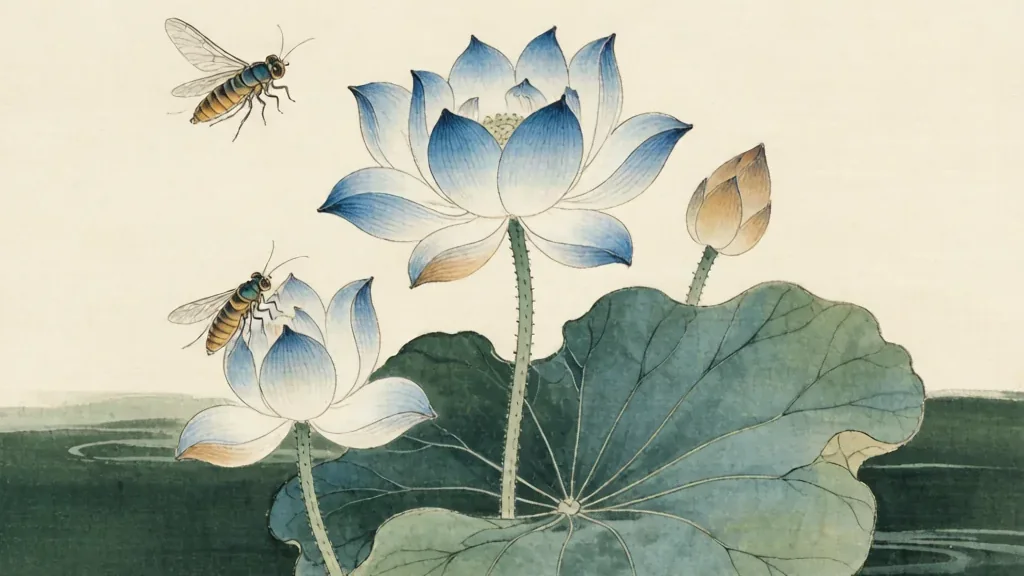
On the longest day of the year, when the sun climbs to its highest point in the northern sky and daylight stretches far into evening, China observes Xiazhi — the Summer Solstice. Occurring around June 21st or 22nd, this tenth solar term marks the official peak of summer, the moment when yang energy reaches its absolute maximum. The name itself, 夏至 (xià zhì), combines "summer" with "extreme" or "arrival," capturing the sense that summer has reached its fullest expression.
The Astronomy of Extreme Light
Ancient Chinese astronomers understood Xiazhi with remarkable precision. They knew that on this day, the sun would appear to pause at its northernmost point before beginning its long journey southward again. The gnomon — a simple vertical stick used to measure the sun's shadow — cast its shortest shadow of the entire year on Xiazhi. In fact, at noon on the summer solstice at the latitude of ancient Chinese observatories, a gnomon eight chi tall (approximately 2.6 meters) would cast a shadow of only about 1.5 chi, a measurement recorded in texts dating back to the Zhou Dynasty.
This astronomical event was not merely an intellectual curiosity. For an agricultural civilization, understanding the sun's annual journey was a matter of survival. The solstice confirmed that the growing season had reached its midpoint, that crops planted in spring were maturing, and that the crucial weeks of summer cultivation lay ahead. The imperial court maintained official astronomical observatories precisely because the calendar was a tool of governance — knowing when to plant and when to harvest was power.
The Philosophy of Peak Yang
In the yin-yang philosophy that underpins traditional Chinese thought, Xiazhi represents a moment of profound philosophical tension. Yang — the principle of light, heat, activity, and expansion — reaches its zenith. Yet embedded within this philosophy is the recognition that the moment of maximum yang contains the seed of yin's return. From Xiazhi onward, even as summer heat intensifies, the days begin imperceptibly shortening. The decline has already begun at the very moment of triumph.
This principle is beautifully expressed in the classical text of the I Ching (Book of Changes), where the hexagram for the summer solstice is 姤 (Gòu), representing "Coming to Meet." The hexagram depicts one yin line forming beneath five yang lines — the first whisper of darkness returning beneath the blazing surface of summer. This philosophical insight encouraged balance: just as nature would inevitably turn toward yin, so too should human activity moderate at the peak of yang, avoiding excess and preserving energy for the months ahead.
Traditional Chinese medicine took this philosophy into practical application. Xiazhi was considered a critical time for health preservation. The heart, associated with the fire element and summer season, required particular attention. Practitioners advised against overexertion during the hottest hours, recommended afternoon naps to balance the heart's energy, and prescribed cooling foods to counteract the season's internal heat. The goal was not to fight summer's yang but to harmonize with it, flowing with the season rather than against it.
Cold Noodles and Summer Fare
No discussion of Xiazhi would be complete without exploring its culinary traditions, and chief among these is the eating of cold noodles. Across China, from the wheat fields of Shaanxi to the bustling streets of Beijing, the summer solstice is noodle day. The tradition is captured in the popular saying: "冬至饺子夏至面" — "Winter solstice dumplings, summer solstice noodles." While winter calls for the warming, substantial comfort of dumplings, summer demands the cooling refreshment of noodles served cold.
The varieties of Xiazhi noodles are as diverse as China itself. In Beijing, zhajiangmian (炸酱面) features thick wheat noodles topped with a savory fermented soybean paste, shredded cucumber, and bean sprouts — the crisp vegetables providing a cooling counterpoint to the rich sauce. In Sichuan, cold noodles arrive drenched in chili oil and Sichuan peppercorn, the paradoxical heat of the spice actually cooling the body by inducing sweat. In Shanghai, delicate cold noodles are tossed with sesame paste, shredded chicken, and a whisper of vinegar.
Beyond noodles, Xiazhi tables feature an abundance of seasonal produce at its peak. Bitter melon, with its cooling properties in traditional medicine, appears in stir-fries and soups. Watermelon, the quintessential summer fruit, is consumed in vast quantities, its high water content and natural sweetness providing respite from the heat. Mung bean soup (绿豆汤, lǜ dòu tāng), simmered with rock sugar and sometimes a touch of lotus seed, is prepared in large batches and kept chilled, served throughout the day as a cooling tonic.
The Ancient Solstice Rituals
In imperial China, Xiazhi was an occasion of state ceremony. The emperor, as the Son of Heaven and the intermediary between cosmic and human realms, performed solemn rituals at the Altar of the Earth (地坛, Dì Tán) in Beijing. Dressed in yellow robes symbolizing the earth, the emperor offered sacrifices to ensure the land's continued fertility and to acknowledge the earth's role in sustaining life. These rituals were conducted with extraordinary precision, for any deviation from proper form was believed to disrupt the cosmic harmony upon which the empire depended.
The common people observed Xiazhi with their own traditions. In many regions, women exchanged colorful fans and scented sachets as gifts. The fans provided literal cooling, while the sachets, filled with aromatic herbs like mugwort and calamus, were believed to ward off the insects and diseases that proliferated in summer's heat. This custom of gift-giving acknowledged the shared experience of summer's challenges and reinforced community bonds.
In southern China, particularly in Guangdong and Guangxi provinces, the summer solstice was associated with dog meat consumption — a controversial tradition that has largely faded in modern times. The belief held that dog meat, being extremely "hot" in the traditional medicinal classification, would help the body expel internal dampness and strengthen yang energy. Today, this practice is rare, replaced by more conventional summer health practices and, increasingly, by animal welfare consciousness.
The Solstice in Literature and Art
Chinese poets have long been drawn to the summer solstice as a subject. The Tang Dynasty poet Bai Juyi wrote of Xiazhi with characteristic blend of observation and philosophy, noting how even as the sun blazed overhead, the first yellow leaves could be found among the green — nature's quiet announcement that summer's reign was already declining. Song Dynasty poets composed verses about the lotus flowers that bloom in solstice ponds, their pink petals a defiant celebration of life at the moment of peak heat.
In visual art, the summer solstice has been depicted through lush landscapes of rippling wheat fields, lotus-covered lakes, and the deep green of midsummer foliage. Traditional Chinese landscape painting, with its emphasis on capturing the spirit rather than the mere appearance of nature, sought to convey not just summer's visual abundance but its energetic quality — the sense of life at full surge, of nature expressing itself without restraint.
In contemporary China, Xiazhi has adapted to modern life while retaining its essential character. Office workers still observe the noodle tradition, ordering cold noodles for lunch. Families still prepare mung bean soup and slice watermelons on solstice evenings. And somewhere beneath the surface of urban routine, the ancient awareness persists — that this day, of all days, the sun gives everything it has, and the world is as bright as it will ever be.
Xiazhi in the Agricultural Year
For farmers the solstice was never only a sky-watching event; it was a hard deadline in the field calendar. Reaching Xiazhi confirmed that spring plantings had matured and that the most labor-intensive weeks of summer cultivation lay immediately ahead. In the warm south, early rice was already ripening while late rice nurseries needed transplanting, and the long daylight gave crews extended working hours. Northern wheat harvests were wrapping up even as millet and sorghum demanded weeding and watering. The imperial court treated the solstice's accurate calculation as a matter of governance, because planting and tax timing depended on it. In this light Xiazhi is best understood as a midpoint signal: the growing season had passed its zenith of light, and the rush to secure the harvest was now fully underway.
Health Traditions at the Summer Peak
Traditional Chinese medicine gives Xiazhi special weight in the annual health calendar. With yang at its height, the heart and the fire element are thought to need the most care, so practitioners advise against overexertion in the noon heat, recommend short afternoon rests, and prescribe cooling foods such as bitter melon, mung bean soup, and lotus seed. The doctrine of 'treating winter illness in summer' also peaks now: clinics apply medicated Sanfu plasters to acupuncture points while the body's pores are open and its yang is strong, aiming to relieve chronic cold-related ailments. Foot baths, light exercise at dawn, and avoiding icy drinks are common guidance. These practices turn the longest day into a therapeutic window, blending seasonal astronomy with preventive self-care.
Xiazhi Within the Solar Term System
Xiazhi is the tenth of the twenty-four solar terms and one of the four pivotal nodes built directly on an astronomical extreme, alongside the winter solstice, spring equinox, and autumn equinox. Its paired opposite is Dongzhi, the winter solstice, and the popular saying 'winter solstice dumplings, summer solstice noodles' deliberately links the two. The term system itself grew from observing the sun's path along the ecliptic, and Xiazhi's fixity — always near June 21 — made it a reliable anchor for the whole calendar. UNESCO's recognition of the solar terms as intangible heritage in 2016 affirmed this precision. Within that framework Xiazhi stands as the bright pole of the year, the point from which the long descent of light toward winter begins.
❓ Frequently Asked Questions
📝 Chinese Vocabulary
- 夏至 (xià zhì) — The Summer Solstice; the tenth solar term
- 冬至饺子夏至面 (dōng zhì jiǎo zi xià zhì miàn) — "Winter solstice dumplings, summer solstice noodles"
- 绿豆汤 (lǜ dòu tāng) — Mung bean soup, a traditional cooling summer drink
- 姤 (gòu) — The I Ching hexagram for summer solstice, symbolizing yin's return
- 炸酱面 (zhá jiàng miàn) — Noodles with fermented soybean paste, a classic Beijing summer dish
🎉 Fun Facts
- In Mohe County, China's northernmost point in Heilongjiang province, the summer solstice can bring up to 17 hours of daylight, and the sky never becomes truly dark — a phenomenon known as "white nights."
- Ancient Chinese used the summer solstice shadow measurement to calculate the circumference of the earth centuries before similar calculations were made in the West.
- On Xiazhi, the Forbidden City's main halls were designed so that the sun's rays would illuminate the emperor's throne at precisely noon, a feat of architectural astronomy that still functions today.
- In several southern coastal regions, Xiazhi was a time to eat lychees and longans, fruits believed in traditional medicine to nourish the body at the height of yang energy.
- Because the day is the longest of the year, Xiazhi was traditionally viewed as an auspicious date for weddings and matchmaking in parts of China.
- The custom of eating cold noodles at the solstice became so fixed that even cities far from wheat country adopted a chilled noodle dish around June 21 as a seasonal habit.